The Sports Archives – Travelling To The Solheim Cup In Germany? Here’s Everything You Need To Know!

Golf

Known across the globe as the female equivalent of the Ryder Cup, the Solheim Cup is a major event and one not to be missed by sports fans. If you are considering making the trip to watch this fascinating weekend of live golf there are a few things you need to know:

Where Is It?

As with the Ryder Cup, each year the two teams – Europe and USA – take turns to host the event. This year is Europe’s turn and the fabulous St Leon-Rot Golf Club in Germany has been chosen as the venue.

This is the first time that Germany has hosted the Solheim Cup and Europe are looking to retain the trophy and set a new record of three consecutive wins. If the golf is as beautiful as the scenery surrounding the course spectators are in for a real treat.

Format

The format adopted for the Solheim Cup varies a little from the regular stroke play that many spectators may be accustomed to. Each match is worth a single point and the players will battle it out for a share of a total of 28 points. In order to be crowned champions, one team must accumulate at least 14.5 points.

Friday and Saturday mornings see the selected players battle it out in foursome matches. Foursomes are made up of two players from each team and those two players must play the same ball alternately. The team that has the best score wins the hole.

Those chosen to represent their teams in the afternoon will play a four-ball format. This is slightly different to foursomes as each player plays their own ball and the player with the lowest score wins the hole for their team.

Sunday brings about the nail-biting climax where all twelve players compete against a member of the opposition in head-to-head singles matches.

Spectator Guidelines

To ensure the smooth running of the event the organisers have released the following guidelines:

  • Smart, casual wear is recommended but spectators are reminded that spiked footwear is not allowed on the course.
  • Cameras are allowed on practice days but in order to give the players a fair chance to concentrate they are not permitted during the event itself.
  • All public areas will have an array of food and drink establishments where a selection of beverages and hot and cold food will be available.
  • Mobile phones are allowed on the course but the organisers respectfully ask that these be kept on silent at all times.
  • Spectators are reminded that no bags greater than 30cm in any dimension will be allowed into the course on match days.
  • No animals are permitted on the course with the exception of guide dogs.

Tickets

A variety of ticket options are on offer to spectators from the official website of the Solheim Cup. Visitors to St Leon-Rot Golf Club can opt for individual day passes or purchase a full week pass that will allow them to witness every point blow-by-blow.

Travel

For those travelling from abroad it is strongly advised that they seek out travel insurance for Germany from Avanti. Getting to the venue is straightforward and the organisers have issued a route planner to help spectators find their way to the course.

Featured images:

Roxanne Seabourne is the Marketing Executive for Avanti Travelcare, who offer European travel insurance for those with pre-existing medical conditions, and are one of very few that have no upper age limit on their policies.

Posted in Golf | Tagged , , , , , , , , , | Leave a comment

The Sports Archives – Archery as a Sport

tassili

The bow-and-arrow began in ancient times, but the competitive elements of wielding it came much later down the line.

Sports born out of weaponry are nothing new in the world. Combat sports go way back in human history; javelin-throwing, for example, can be dated as early in recorded history as 700 B.C., and was founded on the principles of throwing elegant spears with accuracy and power, and with an intention not to attack, but to measure technique. Another “old” combat sport example is ancient boxing, the first recorded game of which occurred around 688 B.C. But one particular sport that stands out to many in the history of mankind is archery. Why is this? Well, while most combat-oriented activities had been refined into a sport long before modern civilization, archery was widely regarded as a recreational activity, almost akin to a form of art, since the creation of the bow-and-arrow around 10,000-9,000 B.C. In fact, archery as a sport is extremely young compared to its counterparts, only seeing the first attempts at becoming a competitive, modern sport around the 1840s. The elements of archery that are practiced as a sport today are somewhat perplexing, but, like any sport, there is much more to archery than one can take from it at a mere glance.

  Did Archery begin as a recreational activity?

Technically, archery began as a combat occupation. Like other forms of modern combat sports, such as martial arts, the primary function of ‘good bowman-ship’ was the ability to fend off and incapacitate enemy aggressors. In a time before the development of gunpowder and firearms, the bow was an elegant, but devastating long-range weapon in the right hands, and saw considerable usage across human history in multiple locations around the world. Eventually, many of the facets of archery – discipline, patience, and so on – which were already present in fighting also became driving forces in the activity’s turn towards recreation. The bow and arrow could be learned by anyone, not just soldiers and militia men, and even if the user had no intention of waging war. Mastering the elements that comprise a skilled bowman was enough of a goal for archery to become a full-fledged ‘hobby,’ and the competitive elements that transformed this hobby into a modern sport would come later down the line. Although archery was practiced as a sport in Ancient Egypt, the rules and methods that went into it are nothing like the modern sport of archery today. One may deduce that any ‘status’ archery held as a sport in Egypt was lost in ancient times, forcing its potential to be rediscovered closer to the modern age.

What led to the transition of Archery into a full-on ‘sport’?

thingstodo_archery

Invigorating like hunting, methodical like golf…competitive archery is another precision-based sport that tests cunning, tact, and technique rather than brute strength or teamwork. Quite exquisite!

As mentioned before, the introduction of firearms heavily disrupted the bow’s previous popularity as a weapon – not only were guns and rifles easier to use without experience, they also fired faster and posed a deadlier threat in the heat of combat. The bow and arrow lost its reputation rather quickly in the realm of war, but it retained its grip on mankind through the hobby outlets which had already developed among enthusiasts. Archery made the leap from recreational activity to full-on, modern competitive sport in 1844; this momentous milestone occurred in York, when the first Grand National Archery Society gathering took place. From there, the sport slowly lost traction in England, and other sports, like tennis, accumulated popularity over a gradual period across the globe. As the number of practicing archery clubs declined, the sport faced extinction.

Facets of Modern Archery

Archery managed to survive, however, and today is popular all over the world. Modern, competitive archery involves competing bowmen firing an arrow over great distances with the greatest accuracy possible. The target at the end of the distance is usually round and ringed, awarding points based on how close to the center the arrow hits when it lands. Points are tallied after a set number of ‘turns’ and the player with the greatest number (i.e. ‘the best accuracy’) wins.

archerycollage

Pop culture and digital media have played a part in promoting archery across multiple generations. Here are four examples, separated by a few years each, which all revitalize the public interest in an aged, yet classic weapon.

Posted in Olympics, Other | Tagged , , , , , , | 1 Comment

The Sports Archives – History of Halftime (American Football & More)!

4 quarters, each slated for 15 minutes of gameplay, and the first and last 2 separated by a brief respite, known quite appropriately as “halftime”; this is the working formula for American football games, as well as rugby matches. The contesting teams play in two 15-minute intervals for each ‘half’ of the game, with a rest period (comparable to the 7th-inning stretch of baseball) offering players and fans alike the opportunity to take a break, stretch, and prepare for the concluding portion of the game. Yet, today, halftime seems to be something many fans take for granted. In fact (again, much like the 7th-inning stretch) most fans of football probably could not give any history on halftime – it has always been a part of major football and rugby sporting events, and to most participants, “it is just something that has always been.” Halftime came from somewhere, however, and many of the more obscure, curious ‘traditions’ of football actually originate from it. Here are 5 major points that overview the history and development of halftime as a fundamental component of sports…

  1. Halftime started in English “public schools” – In the early 1800s, the first codes, or ‘rules of engagement,’ of football were established in the English public schools; take note that the term “public school” in England is actually more equitable to the private schools of the U.S. and other countries. By extension, even though football (and rugby) is widely considered ‘the every-man’s sport’ today, it could be considered as having “noble origins,” as the schools of its upbringing catered largely to upper-class, wealthy students, who were mostly male. The environment of these English public schools served as a perfect proving ground for football’s early years.

    download (3)

    Hard as it may be to believe, football was established in the likes of this; an English public (preparatory) school.


  1. Early halftimes highlighted a change of rules – Before the rules of football became universal in the mid-late 1800s, halftime instituted a swap of actual rules, based on the model of football/rugby at the particular school of one of the competing teams. Halftime also featured a swap of field positions for the competing teams if neither had scored by halfway through the game (although the teams would also, traditionally, swap each time one of them scored). After football acquired a more consistent ruleset, only the practice of changing up positions on the field remained. It is still prevalent in today’s football, coined with the same effort of “reducing or diminishing any advantages or disadvantages the respective teams may have been experiencing in the first half.”


  1. Halftime is featured differently across a wide variety of sports – Even though halftime may have originated in football or rugby, it is a highly-significant component of many other modern sports now, including handball, basketball, field hockey, bandy, and lacrosse. The duration of halftime has been known to vary based on the sport, as well, with American football’s and Lacrosse’s lasting 12 minutes in the NFL and NLL, respectively (although 20 minutes is standard for College-tier football), handball’s lasting 10 minutes, basketball’s lasting 15 minutes, and bandy’s lasting as long as (but not in excess of) 20 minutes.


  1. The first Super Bowl “halftime show” was in 1967 – This was also the first year in the NFL in which the “Super Bowl” was to be played. Super Bowl I took place at Los Angeles Memorial Coliseum in California, and featured the University of Arizona Symphonic Marching Band, as well as the Grambling State University Marching Band as the musical performers. While halftime shows can and do happen at any tier of
    download (2)

    The University of Arizona Symphonic Marching Band was among the few who kicked off the tradition of an organized, halftime ‘show.’

    American football, the Super Bowl halftime show is renowned for its sociocultural significance and sheer size (both monetary and spiritual!). The more recent Super Bowls featured performances from pop culture idols and renowned musicians, such as Katy Perry, Beyoncé, the Red Hot Chili Peppers, the Black Eyed Peas, and more.


  1. Halftime performers are generally not paid a commission – this one may be surprising! Famous celebrities and bigtime performers that appear to liven up halftime shows aren’t actually paid for their gig (at least not for the Super Bowl…). Instead, only the production expenses of the performances – payments that go towards equipment, setup, and props – are covered. Essentially, performers are given the opportunity to showcase at the NFL Super Bowl for no cost. They’re doing it all for you!

    SBowl

    Today, the Super Bowl is one of the most popular, celebrated components of Professional American football. At the same time, the halftime show of this renowned pastime has served as a platform to elevate the performing and musical arts of today’s pop culture.

Posted in College Football, Football, Other, Rugby | Tagged , , , , , , , | Leave a comment

The Sports Archives – The Oldest Standing Ballpark in the U.S.A.

Arcadia_Park_Field_2012-5-6_large

A ballpark can, in one way, be equated to a church; The people and players that fill the space are what make baseball what it is, and though the memorability of each ballpark may vary through class, popularity, historical significance, or sheer size, any and every field can be special!

Every sport begins somewhere, and the same holds true for baseball. Renowned as America’s pastime, this sport’s history centers largely within the U.S., and even over a century later, the heart of baseball continues to beat with uproarious fervor, now not just in its home nation, but across the globe. Today, America’s claim to the treasured sport is irrefutable, but even so, how does the history of baseball carry weight in the United States? The intimate relationship of the sport with the American people is strengthened firsthand by the community’s enjoyment and commitment to the special sport over the years; however, baseball’s history in the U.S. also lives through the sport’s material claim to the Earth! Perhaps the largest of such “relics” which stake and sustain the legacy of baseball are the parks in which the timeless sport is played.

What is the Oldest Baseball Stadium/Ballpark in the United States?

Much like the origin background   of baseball itself, it would be pretty difficult to fish out the true story regarding the first baseball field in the United States. Isolating the oldest ballpark in the U.S. is also complicated by where the ‘line of recognition’ is drawn; a small dirt field with barely any semblance to a baseball stadium could not possibly be considered the first real baseball park in America, could it? Where is the line that separates old, amateur ballfields and the big-league professionals?

The Oldest Surviving Professional Ballpark in the United States is…

The oldest Major-League Baseball field, which is still in use today, is certainly an excellent choice for recognition. This prestigious title is held by none other than Fenway Park, home of the Boston Red Sox and based in the heart of Massachusetts. Constructed in 1912, Fenway Park is over 100 years old today, and has seen hundreds of Red Sox players guard its field with passion across the history of its existence. The seating capacity of this field was 35,000 when it first opened (as of 2015, this number has expanded to approximately 37,000) and it boasts several notable features, such as the towering, green left-field wall known as The Monster. In May of 1999, Red Sox CEO John Harrington proposed the construction of a brand-new baseball park nearby the original Fenway Park, which would assume the role and title of its predecessor, but more modernized and replicative. The idea fell through when it sparked conflict between multiple parties involved in the decision, including a hefty majority of the Red Sox community (among whom the proposal was decidedly not popular). In 2005, plans to rebuild Fenway as a new park were formally discarded and the existing field was updated. Fenway Park is presently intended to serve as a playing field in Major League Baseball for several more decades.

Untitled

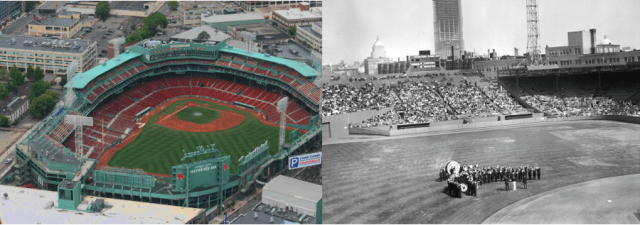
Fenway across 2 different centuries in American history. Some of the seats may be newer, the scoreboards may be more hi-tech, and the players might lie generations apart, but the spirit is one thing (among even a few physical facets of the park itself) that remains unchanged.

Despite Fenway Park’s prestige as a 100+ year old MLB field, there is something inexplicable about it that makes it less-entrenched in the commercialism of sports – a turn the industry has taken over the past century – and more concentrated on the love, passion and enjoyment of sharing America’s pastime. Perhaps it is the generations born into this park and team, or maybe it is just age. Suffice it to say, however, that Fenway is a centerpiece in the legacy of its sport and will continue to play a role in American baseball throughout the 21st Century.

Posted in Baseball, Other | Tagged , , , , , | Leave a comment

The Sports Archives – Martial Arts: Competitive and Aesthetic

A sport mandates 2 main criteria – competitive spirit and a test of the participants’ physical or mental conditioning. In fact, there are even some athletics that are regarded as sports which only meet one of these criteria, but regardless, provided that these are present in some fashion, there really is no reason not to consider a social or cultural activity a “sport.” Sports come in a variety of styles and mechanics, but they each earn their recognition through the fact that they inspire competition, teamwork, and passion in participants. Yet, when it comes to examining the array of activities that could be classified as sports, drawing a line that separates the competitive from the purely-recreational is exceptionally difficult. This is because the potential for “becoming” a sport is present in nearly everything – the deciding factor is whether an activity can be portrayed in a sporting way. Consider, as an example, painting; it is presently unfavorable in society to recognize painting as a sport, because the competitive potential of it has not been manifested in a division, organization, or event of the activity. Instead, painting is widely acknowledged as a form of art – something that explores and deepens humanity (and its many qualities) without involving the aspects of human rivalry that classify a sport. But what if an activity can be both an art form and a sport, even if not necessarily at the same time? What if something can be considered artistic in some ways and competitive in another? One of the most profound (but discounted) examples of this unique ‘hybrid sport’ is found in the field of martial arts.

basic form 2

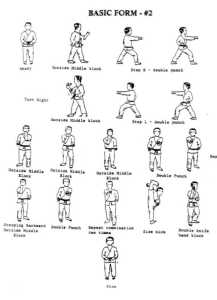
Forms are a component of the more artistic side of martial arts. Imagine choreographing a dance routine or stage performance using only self-defense moves!

Not only are the martial arts diverse (there are a plethora of various fighting techniques and “root” styles, originating primarily from the countries of Japan, China, and Korea), but they can be practiced, instructed, and celebrated in multiple fashions. The artistic facets of martial arts manifest themselves in a variety of ways, including the elevation of a clean fighting technique and the vigorous refinement of forms – eloquent, methodical sequences of moves that can be considered the martial arts-equivalent of dance numbers. The sporting elements of martial arts, on the other hand, are most notable in the live sparring of two students or, more generally, in its physically-demanding, “martial” nature. One of the greatest elements of martial arts like Kung Fu, Karate, and Tae Kwon Do is the variety that can be pulled from the aspects that define them; participants and practitioners are able to capitalize on a selection of said aspects which best suits them, much like a baseball player may become a pitcher or batter for their career. Likewise, martial arts students may choose to focus solely on the development of forms, while others may favor the sparring. Martial artists who choose to specialize are not any less artistic, nor athletic, for their decisions.


tcd

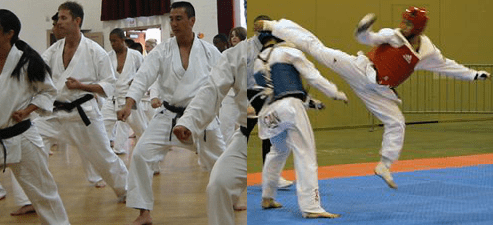
This image compiles the 2 fundamental components that go into martial arts as a sport. On the left, group forms are executed with focus, discipline, and teamwork. On the right, 1-on-1 sparring demonstrates the competitive nature of martial arts, and clearly displays just how physically taxing such activities can be.

What else about the science of martial arts makes it an activity worthy of recognition as a ‘sport’? Remember that no sport is capable of prevailing without support. A sport’s following – fans and people who have dedicated and committed themselves to the instruction, evolution, and endurance of a sport – is what completes it. The same holds true for martial arts. In the United States, approximately 18 million individuals were involved in martial arts over the past year. Additionally, martial arts schools across the U.S. number close to 30,000. Each year, in America alone, numerous Tae Kwon Do competitions are held at the regional, state, and national levels, and participants follow what they do as passionately as any sports player. The sporting nature of these arts is most relatable at said competitions, where students from various locations across the country congregate and compete with each other. Forms are compared, sparring matches take place, and, most importantly, comradery develops out of a shared passion for one’s pursuits; such traits are just as common in any major sport.  Tae Kwon Do is just one form of martial arts you should learn.

AAU-LOGO

The Amateur Athletic Union also supports martial arts in the United States, from a respectively less-competitive standpoint.

download (1)

The United States Martial Arts Association functions as a nonprofit “governing body” to unify and sponsor martial arts divisions and denominations in America.

In upholding the importance of both artistry and healthy competition in human life, and with a tremendous community of committed followers, the realm of martial arts has defined itself as well as any sport across the globe. Perhaps it may seem peculiar that a sport which promotes concepts like fighting and combat proficiency could achieve such popularity among a vast public body, but, truthfully, martial arts is so much more than a fancy method of hitting someone.

Posted in Fitness/Wellness, Other | Tagged , , , , , | Leave a comment

The Sports Archives – Dangers and Hazards that can shut down Golf

Interested in getting involved in golf? Maybe you already play recreationally and want to take your skills to the next level. Golf can easily be described as one of the more laid-back, relaxing sports, but in actuality, it is rife with stress, tension, and also great reward. Like many other sporting activities, what you see is not necessarily what you get; a lot more goes into golf than just the sendoff swing – and the swing is a difficult technique to master by itself! Golf is a game of strategy, planning, and level-headedness, and even the greatest players may find themselves seriously afflicted by some of the dangers and hazards on the field of play. Here are a few things to watch out for if/when you find yourself in another game of golf…


download

Sand is clumped, jagged, and unstable. It is very easy for a ball to become ensnared in a bunker, and equally difficult for it to be removed. It is probably best to just aim well and play it safe rather than take a risky shot!

Field Hazards: If the sport of golf could be boiled down to two components, it would be the player’s swing and the course the ball must traverse to reach the hole. No golf course is simple in construction, and much planning and analysis goes into creating the ideal field of play. Most field hazards distributed throughout a game of golf are implemented by choice – they are manmade, and added to keep play interesting and competitively restrictive. The two most common forms of field hazards are water traps and bunkers. Water traps, as the name implies, are manmade or natural bodies of water around which the golf course has been constructed. They pose an obvious threat to golf balls and practically guarantee (should the ball become ensnared) that players will suffer a penalty stroke in retrieving it. Bunkers, also known plainly as sand traps, are small, manmade valleys in a golf course filled with sand. While at face value, sand may not seem quite as halting as water, the player’s momentum should the golf ball land in a bunker is nonetheless disturbed. The player has an opportunity of hitting the ball out of a bunker without suffering the penalty stroke in moving it, but they may not practice their swing before hitting the golf ball out of a trap. If the player is not careful and concise, they may lose several swings over trying to remove the golf ball from a bunker.

Moon-WaterHazard

This course features 2 sand traps and a partitioning water hazard. Yikes!

130222101059-golf-snow-balls-horizontal-large-gallery

Forget about how different snow would make a game of golf; can you imagine trying to find a standard golf ball when all of the ground is white?!


Weather: Course traps are the most blatant threat to a golfer’s game, but many more dangers can potentially populate the field – dangers which are more sporadic and play-influencing than others. For sports like baseball and football, weather conditions like rain, strong winds, and even hail can complicate and shut down gameplay. Given that golf is much more intricate and delicate than other sports, the influence of the weather is compounded. The golf course might as well be an entirely different playing field in the rain; the wet ground completely changes traction and movement for the golf ball, and the dense, wet air can constrict even the most elegant swings. Golf is so delicate, even dry air temperature can have a major influence on playability and approaches players must take – colder air is slightly denser, and as such, the ball will have a tendency to lose a little bit of the flight it would gain from a similar swing on a warmer day. Despite how unfavorable (apart from a balmy, dry day with the sun shining) the weather can be, there are a few beneficial aspects to certain weather conditions; rain will indeed wet the ground, but this also leads to wet bunkers. Sand that is dampened by water will actually clump up and make it easier to hit the ball out of such traps. Additionally, while the coarser terrain on the field will become slick as the result of the rain, the “greens” that surround the hole at the other end of the golf course will not. Putting shots will need an extra bit of force behind them, and the ball will not curve nearly as much, which could make longer putts easier. Like with any outdoor sport, lightning storms are very dangerous, especially for lone players swinging with metallic golf clubs in the midst of an open field. Play it safe and don’t risk electrocution!

golf-shot-from-10th-tee

It may not seem like such a big deal, but the temperature and climate in which a golfer plays can seriously affect their performance. Identical shots taken in 2 different air temperatures start off pretty much the same, but the amount of flight the golf ball will experience differs dramatically later on!

            The threats on a golf course certainly abound, but this should never discourage an enthusiastic beginner or recreational veteran! Like with any sport, a good golf player is built by perseverance, an enduring spirit, and lots of practice. Approaching hazards in golf is all about strategy, logic, quick thinking, and taking the best shot possible. As for bad weather…maybe staying indoors and waiting for a clearer day isn’t such a bad idea!

Posted in Golf, Other | Tagged , , , , , , , , , | Leave a comment

The Sports Archives – Preview Of The FEI European Championships Aachen 2015

horseback riding

From the 11th through to the 23rd of August, around 450,000 people are expected to visit Aachen, Germany, for the 2015 Fédération Equestre Internationale European Championships. With five main events on show, 2015 looks set to be a phenomenal year.

The best horses and their riders will be fighting it out for the coveted medals across the 13 days and there are sure to be plenty of thrills and spills to keep the audience entertained and on the edge of their seats.

Who will emerge victorious and take the gold this year? Britain will be hoping for victory from Charlotte Dujardin, who is defending her European title, but German riders Isabell Werth, Jessica von Bredow-Werndl and Kristina Bröring-Sprehe will be hoping for some inspiration from the home crowd.

A Grand Return

This is not the first time that Aachen has played host to the equine elite. Back in 1958, the European Show Jumping Championships were held here, only the second in what has proved to be a long running series.

Things have changed somewhat since the early days, however, and the huge crowd are now treated to a spectacle that involves five equestrian disciplines as opposed to the singular events of yesteryear.

Aachen is steeped in equestrian history and many regard it as one of the finest showgrounds for the sport across the world. This has been further enhanced by the erection of an entirely new stand in the Deutsche Bank Stadium, built specifically for the 2015 event.

The Opening Ceremony

The stage is set for the 11th August 2015, where those lucky enough to have a ticket will be able to witness the spectacle of the history of Aachen-Laurensberger-Rennverein acted out before them. Some of the worlds most proficient riders will be on hand to delight the crowd with a show that will provide unforgettable moments as they re-enact famous moments from the organisations long history.

The Disciplines

The disciplines on show here this year go far beyond the usual show jumping and dressage. With the addition of reining, driving and vaulting, this year’s event looks set to be the highlight of the equestrian calendar.

Of course, the two main events will still be the show jumping and the dressage, but the addition of three further disciplines will no doubt add to the enjoyment of the crowd.

Tickets

Tickets are still available via the Aachen 2015 website. However, as one would imagine, these are selling fast. A maximum of 6 tickets per day, per customer are available, so the opportunity for a fabulous family day out is there should you wish to enjoy it with your loved ones.

Getting There

International travel is made easy by the fantastic links to and from the championships. The A4 motorway is the most direct route by car, either through Germany itself or if you are entering the country via the Netherlands.

Public transport serves the area well too, with both bus and train coverage ensuring a smooth journey for all who choose to use these modes of transport.

For those travelling from abroad, European travel insurance is strongly recommended. Being prepared for any eventuality will allow you to fully enjoy your stay in this fabulous part of Germany.

Featured images:

Roxanne Seabourne is the Marketing Executive for Avanti Travelcare, who specialise in travel insurance for those with pre-existing medical conditions, and are one of very few that have no upper age limit on their policies.

Posted in Horse Racing | Tagged , , , , , , , , , , , , , , | Leave a comment

The Sports Archives – How To Get Into Sailing

sailing pixabay

It’s diverse, it’s won Team GB plenty of Olympic medals in the past, and it’s a sport that’s enjoyed by competitors and leisure users alike. We’re talking about sailing, a sport that’s open to all, and one that is fairly easy and affordable to get started in, thanks in part to the wealth of sailing clubs, courses, and holidays run throughout the UK and beyond.

What’s available?

Sailing opportunities available often include windsurfing, one of the fastest forms of sailing, where you can reach up to and over 50 mph, along with yachting and dinghy sailing. Activities and courses may vary depending on the club facilities and the location/conditions, but there are plenty of choices, and you don’t always have to be a member of a sailing club to join in.

Who can sail?

The best answer is almost everyone. Many sailing clubs impose a lower age limit of 8 years old, but apart from that you don’t have to be fit or able-bodied to have a go. There are different types of boats and sailing to suit all. Your local club may have activities available to suit disabilities, and youth sailors can typically learn the basics in a dinghy, and perhaps progress to a youth wind surfing course. Check out details of your local sailing courses and you may well find equipment is included, along with instruction, and you may get fed as well, so it’s often an affordable way to get involved.

How Can I Take To The Water?

Look out for novice or complete beginner courses that require no experience. These could be taster courses over a weekend which will teach you the basics of sailing, and introduce you to what sailing schools are all about, or for something a little more involved, try a competent crew option. Typically over 5 days, these courses cover day and night sailing, knots and rope work, sail handling and more. If you choose to progress further into sailing, some courses will give you the nautical miles or skills needed for more advanced qualifications.

Another option is to book onto a sailing cruise. This is a great way to get friends and family involved, and you can all socialise, work and learn together and enjoy the experience of cruising the open waters and seeing some of the wildlife and coastal scenery across the UK. Experienced skippers will lead every cruise, but there’s plenty of chances to get involved if you want to learn more about navigation, setting sail, passage planning, or other aspects of cruising the waters.

Where To Find Out More?

If you’re not sure if your local area has a sailing club, then check out the Royal Yachting Association or their Welsh, Scottish or Northern Irish equivalent. There you will find a directory of sailing clubs running RYA approved courses, details of programmes such as RYA Push The Boat Out, and RYA Sailability which promotes disability sailing, and ONBOARD which focuses on windsurfing and sailing for young people.

You could also visit your local travel agent or specialist operator and find out options available for cruising and sailing adventure breaks, or check out pages such as Get Inspired on the BBC Sport page. Combine all these resources with books, videos, blogs, maybe even a trip to a sailing regatta or club open day and you’ll have every chance to find out about all the benefits of sailing, and how to get involved. Maybe you’ll even inspire others to take up the sport.

Featured images:

Simon King runs Broad Reach Sailing, which offers RYA sailing courses on the Solent on the South Coast.

Posted in Other | Tagged , , , , , , , , , , , , , | Leave a comment

The Sports Archives – Baseball Science: Batting Power & Precision

0516_Baseballbats-1

Basic anatomy of the standard baseball bat.

Last month, The Sports Archives released an article discussing the intricacies and mechanics of pitching in baseball. Pitching is instrumental in playing this sport, but what about the other end of the stick (literally)? Batting is the yin to pitching’s yang – a complimentary opposite to the game mechanic that kicks off every action in baseball – and said sport can certainly not be played without both. Novice beginners, recreational players and even spectators of baseball are often curious about how batting works – what is the science behind striking the ball with a long pole, and how does experience and practice improve someone’s ability to do that? The resolution to this line of inquiry is a compound answer…

Pacing of the Swing – Perhaps the most basic concept in successful batting is the timing of the swing itself. It may be strange for some to think that the trajectory of the ball is so comprehensively flexible based purely on the timing of a pitch, but this is the truth. Much like pitching, batting is unique on a per-player basis; as such, it is difficult to teach or describe a singular, global method that reinforces how a player should strive to bat. While this means that each individual batter must discover their habits, strengths, and weaknesses alone, they are not entirely without help. Some aspects of batting remain truthful regardless of the person making the swing, and these facts can be very helpful in personally “calibrating” one’s batting technique:

  • If the swing is too late, the ball will make contact with the bat too early in the swing, and the resulting arc with bank too far to the right for right-handed batters (and too far to the left for left-handed batters)
  • If the swing is too early, the ball will make contact with the bat too late in the swing, and the resulting arc will bank too far to the left for right-handed batters (and too far to the right for left-handed batters)
  • Ultimately, batters should focus on just hitting the ball first, but as they develop a personal rhythm for batting, they should refine their technique so the ball starts to gain consistency aligning in the middle of the field when hit.
recoil

The sweet spot happens to overlap a variety of factors which make it the ideal impact point. Feedback vibrations are the lowest in its borders, and because it is located near the end of the bat, the force with which a player swings is compounded because of angular force, or “torque.”

The Core Physics – So, where does the speed and power of a stricken ball come from, exactly? Everything that goes into the swinging of the bat for a hit can be traced back to kinetic energy. Kinetic energy is put into the swing via the batter; when the player swings the bat, force is expelled through his motion. When the bat strikes the baseball, a variable portion of the harnessed kinetic energy is transferred to the ball, sending it flying through the air. Any kinetic energy that is not delivered to the ball on hit will reverberate through the bat, creating excess vibration. Experienced baseball players often refer to a “sweet spot” in hitting – a point on the bat where striking the ball is ideal to maximize performance. Scientifically speaking, this is the location on the bat where the maximum possible kinetic energy will transfer to the ball. Simultaneously, hand sting – the painful effect of the bat vibrating on human hands – will be minimized, because most kinetic energy will have left the bat.


baseball-bat-comparison

The differences in each material of bat are made clearer here. It should be noted that even though a wood composite bat is shown here, any type of bat could be considered to be made composite, provided it is constructed from more than one primary material.

Baseball Bat Materials – The size of baseball bats has varied in the past, and the materials composing them vary to this day. Historically, baseball bats could weigh up to 3 pounds, though this has slowly reduced over time. Today, baseball regulations control the precise size and weight of bats respective to each division of competitive play. The science of materials composing a baseball bat becomes more intricate as a researcher goes deeper – the 3 major manufacturing categories for baseball bats, however, are wood, aluminum, or composite material. The first two are fairly self-explanatory; wooden bats are fashioned from a type of wood (and varying types of wood can give individual bats certain characteristics) and aluminum bats are made of the signature lightweight metal. Composite bats are made from a complex carbon fiber polymer, which gives the bat distinct attributes that make it better or worse than the other two types of bat. Material plays a fairly significant role in the structure and performance of a baseball bat, but none is truly more advantageous or disadvantageous than another. Aluminum bats do not risk splintering like woodenbats, but may cause more hand sting due to the resonance of the ball impacting on the bat; composite bats have superior durability and strength compared to the other two types of bat but are not ideal in cold temperature, and so on…

Wood-Characteristic-Chart

The specifics of how each type of wood changes a bat’s playstyle become apparent when different sub-types of material are examined.

These are the basics of the science behind batting in baseball. The details of this process only get more intricate with greater investigation, but the fundamentals boil down to materials, physics, and timing!

Posted in Baseball, Other | Tagged , , , , , , , , , | Leave a comment

The Sports Archives – 10 American Football Vocabulary Lessons for New Fans

newseventsimages

While baseball may forever remain the U.S.A.’s pastime, American Football has achieved tantamount popularity with the nation as its #1 most popular Major-league sporting activity. So get ready to join the club of football fanatics!

Perhaps you were at a friend’s house one time and caught a glimpse of good-old American Football on the television, or maybe you’ve followed football for quite a long time, but still aren’t entirely familiar with the intricacies of the game. While it is certainly one of the easier sports to comprehend both as a spectator and as a player, football still possesses the precise, detailed complexity that defines any great sporting activity. What American Football ultimately boils down to is the skill and strategy of each team, and how they will, for a select period of time, be in charge of either moving the football itself to the end zone or preventing the team carrying it from encroaching. Everything else that composes the game is just an addition to play that molds and shapes what the players will do next. Here are 10 of the more vital terms and policies employed in a football game when all of the action happens:

Down – Downs are perhaps the most crucial resource in a game of football, and signify “turns” in which the offense may move the football forward along the field. Once the offensive team has possession of the ball, the players will position themselves along a yard line that coincides with the football in the middle of the field. The offensive team effectively has four “chances” – four downs – at a time to move the ball 10 yards forward. The defensive team must prevent the ball from moving towards the goal by stopping each play that the offensive team executes. Only one play can be executed per down. If the offensive team manages to move the ball 10 yards, the down system is reset and the offense may continue with a 1st down. If the defensive team is successful and all four downs elapse without the ball moving 10 yards, the teams switch and the defense team has a chance at playing offense.

Offense – Shorthand/slang for the team in possession of the football.

Defense – Shorthand/slang for the team defending.

c2

The Line of Scrimmage is the blue line projected on the field below. This line, the yellow line, and the text palette “3rd & 5” are applied digitally to the video feed and are seen in most televised football games. Of course, in person, none of this is visible, but spectators watching on TV can keep up as well as (if not, better) any fan present in the stadium.

Line of Scrimmage – The Line of Scrimmage is an invisible line that runs the width of a football field, and signifies where the football is on the field. The line separates the offense and defense teams from each other up until the offense initiates a play.

 Possession/Interception – Possession is another way of defining which team has control of the ball (and, by extension, conducting the offensive). Generally, the downs dictate when each team plays offense and defense, respectively. However, if a member of the defensive team manages to legally (without penalty) acquire the ball while a play is in effect, the teams automatically switch out and the previously-defensive team now has possession. This is known as interception.

Fumble – If a player is in control of the football and loses/drops it before being tackled or halted, it is known as a fumble. Fumbles are slightly more common in passes, but can happen at any point in time. Typically, when a player is tackled, the play concludes with the ball falling at the respective yard line, but in a fumble, the football is still considered a “live ball,” and can be recovered by either time. Like with interception, it is typically possible for the defensive team to assume possession of the ball if they recover it from a fumble.

Blitz – Blitzing is a tactic often utilized by the defense to confuse the offensive team and disrupt a play. Normally, the defensive team tries to balance its players between pressuring the quarterback and blocking potential pass candidates. In contrast to this, a blitz is generally defined as “a defensive rush executed by more than 4 defensive players.” Timed properly in a game, a blitz can make all the difference, but it is still a risky maneuver – the more defenders that are sent after the quarterback at the start of the play, the less remain to prevent a successful catch if the ball gets away.

2-flag

This is the weighted, yellow penalty flag referees throw out during play. Even if you missed the penalty happen, if you see this on the field, you’ll know that someone is about to get hosed!

Flag/Penalty – Penalties are issued in football by a referee, usually by way of a weighted, yellow flag that is thrown onto the field. The plethora of infractions in football is notably diverse, but the penalties for such are really not. Most penalties assigned by referees for infractions consist of a loss in yardage – forcing the offense or defense to acquire or concede what is considered a fair distance towards either goal. It is possible, however unlikely, to gain an automatic first down on yard penalties alone.

Roughing/Holding – Football is a contact sport; as such, there is going to be a lot of roughness from both sides, but the aggression does not go unchecked. Roughing is a penalty infraction categorized as the illegal tackling of a player. Tackling is usually legal only on the player in possession of the football. As such, “roughing the ____” is an expression that describes an accidental tackle of a player, be it the kicker, the passer (after a pass), and so on. Holding also involves physical contact, and is categorized as when a player physically handles another player that is not in possession of the ball. It can get uncomfortable dancing around opponents at times, but shoving, tackling, and overtaking receivers or defenders is usually not allowed (unless they have possession, of course).

Scoring – Scoring can be perplexing in football – where do all those points come from? It   is simpler than it seems, really. A touchdown results in the most points, and is simply when an offensive player makes it to the end zone with the ball in hand. A standard touchdown is 6 points, with an optional 7th and/or 8th granted by a “free kick” or, if the offensive team manages to execute another touchdown from short range in one play, respectively. If the team is close to the end zone but short on downs, they may opt to “punt” the ball – kick it through the goal post in the end zone. This is a “field goal” and is worth 3 points if it connects.

Now you know most of the fundamentals needed to grasp football. Get out there and prepare for football season this autumn!

Posted in College Football, Football | Tagged , , , , , , , , | Leave a comment