
Few soccer players have combined athletic brilliance, international fame, and national expectation quite like David Beckham. By the time the 2006 FIFA World Cup arrived in Germany, Beckham was already one of the most recognizable athletes in the world. The England captain had enjoyed success with Manchester United and Real Madrid, established himself as one of soccer’s greatest free-kick specialists, and become the public face of English football.
Yet the 2006 World Cup would become one of the most emotional chapters of his career. It featured a spectacular winning goal, a historic individual achievement, a heartbreaking elimination, and the end of his six-year reign as England captain. For Beckham, the tournament represented both a personal triumph and the closing of an important era.
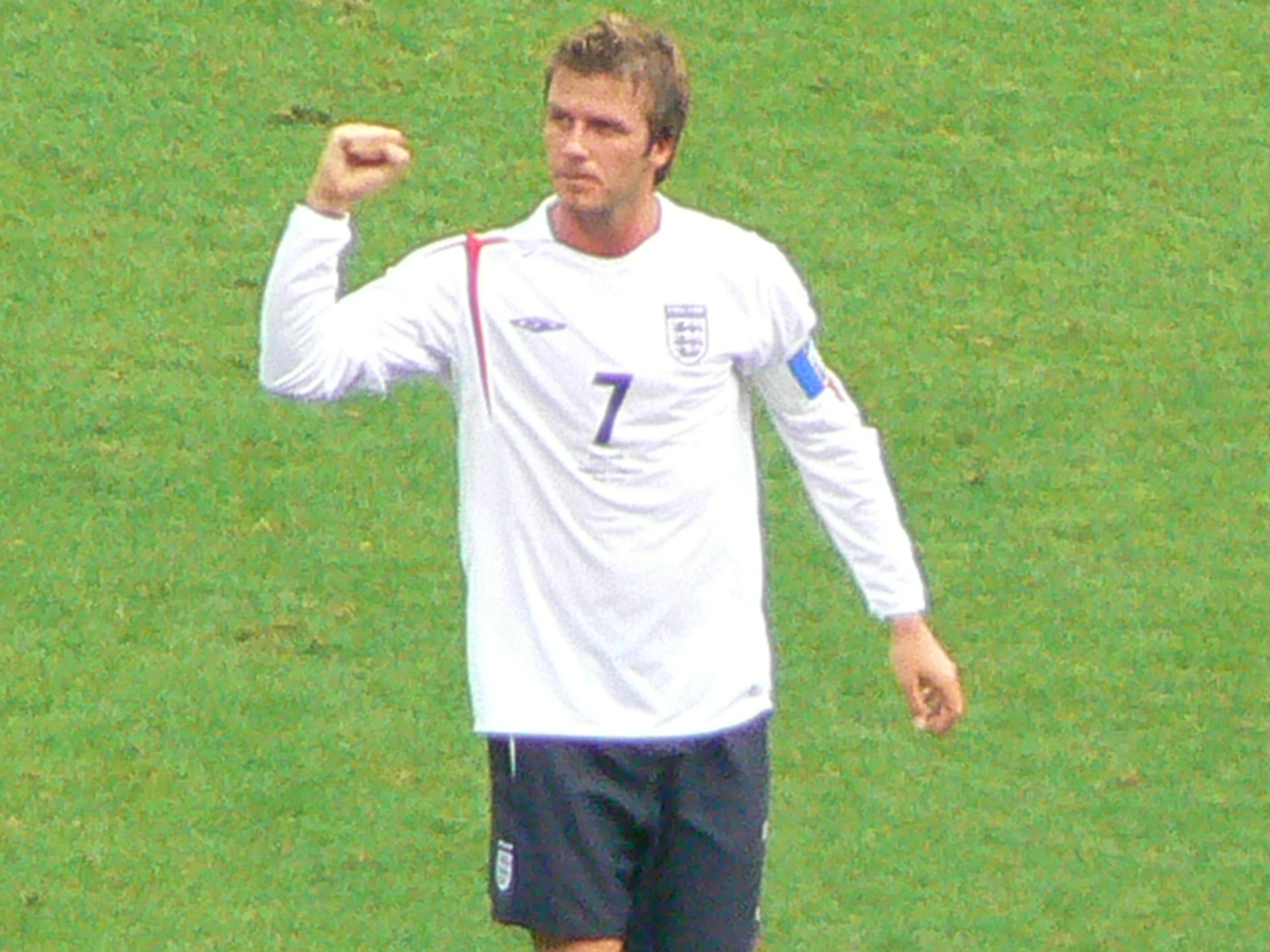
Image source and public-domain declaration.
England’s Captain Under Enormous Pressure
England entered the 2006 World Cup with one of its most talented squads in years. Alongside Beckham were stars including Wayne Rooney, Steven Gerrard, Frank Lampard, John Terry, and Rio Ferdinand. Expectations were extremely high, with supporters believing the team could challenge for its first World Cup championship since 1966.
For Beckham, the tournament carried additional significance. He had experienced the humiliation of being sent off against Argentina during the 1998 World Cup, then earned redemption by scoring the winning penalty against Argentina in 2002. Now, at 31, he was determined to lead England deep into another major tournament.
The Sports Archives Blog has previously explored England’s international football history in Cole on Course for a Century, which discusses Ashley Cole, Beckham, and the players who represented their country at the highest level.
A Difficult Beginning in Germany
England opened the tournament against Paraguay on June 10, 2006. Beckham’s dangerous free kick created the decisive moment when Paraguay captain Carlos Gamarra headed the ball into his own net. England escaped with a narrow 1-0 victory.
Five days later, England faced Trinidad and Tobago. The match remained scoreless until the closing stages, when Beckham delivered a precise cross that Peter Crouch headed into the net. England eventually won 2-0, with Beckham also contributing to Steven Gerrard’s late goal.
Despite the victories, England struggled to develop the fluid attacking style many expected. Critics questioned the team’s tactics and midfield chemistry. Beckham, however, continued to demonstrate why his passing accuracy and delivery from set pieces remained indispensable.
The Free Kick Against Ecuador
On June 25, England faced Ecuador in the Round of 16 at Stuttgart’s Gottlieb-Daimler-Stadion. The afternoon was brutally hot, and both teams struggled to generate sustained attacking pressure.
With the match scoreless near the hour mark, England received a free kick roughly 25 yards from goal. It was precisely the kind of opportunity that had made Beckham famous.
The England captain stepped forward and struck the ball with his trademark technique. The shot curled over the defensive wall and bent toward the near post. Ecuador goalkeeper Cristian Mora managed to get a touch, but the ball slipped into the net.
England led 1-0, and the crowd erupted.
The goal was especially significant because Beckham became the first England player to score in three different World Cup tournaments, having previously scored in 1998 and 2002.
Even more remarkably, Beckham had been struggling with illness and dehydration during the match. Despite feeling physically exhausted, he produced the moment of brilliance that carried England into the quarterfinals.
Portugal Ends England’s Championship Dream
England’s next opponent was Portugal, a talented side featuring Cristiano Ronaldo and several experienced international stars. The quarterfinal, played July 1, became a tense and emotional contest.
Beckham suffered an injury during the second half and was forced to leave the game. Cameras captured the England captain sitting on the bench in tears, knowing that his opportunity to influence the match had ended.
England continued fighting, even after Wayne Rooney was sent off, and managed to hold Portugal scoreless through extra time. The contest eventually went to a penalty shootout, where Portugal prevailed 3-1.
For England, it was another heartbreaking World Cup exit. For Beckham, it marked the end of his final World Cup appearance as captain.
The Emotional Decision to Step Down
On July 2, 2006, one day after England’s elimination, Beckham announced that he would relinquish the national team captaincy.
The decision was deeply emotional. Beckham had worn the captain’s armband since 2000 and considered representing his country one of the greatest honors of his career.
He explained that a new England manager and a new era made it the appropriate time for another player to lead the team. Although stepping down as captain, Beckham made clear that he still hoped to represent England as a player.
John Terry eventually succeeded him as captain, while Beckham continued his international career, ultimately earning 115 appearances for England.
Beckham’s Influence Beyond the World Cup
Although England failed to win the championship, Beckham’s 2006 performance reinforced his status as one of the sport’s most influential figures. His free-kick technique, passing ability, and global popularity helped make soccer accessible to fans far beyond England.
The following year, Beckham joined the Los Angeles Galaxy, bringing extraordinary attention to Major League Soccer in the United States. His arrival represented another important chapter in the international growth of the sport.
The Sports Archives Blog has previously discussed the worldwide appeal of soccer in Why Is Football (Soccer) the World’s Most Popular Sport?. Beckham’s international influence is a particularly strong example of how individual athletes can help expand a sport’s global audience.
Watch David Beckham’s Famous 2006 World Cup Free Kick
Relive David Beckham’s spectacular free kick against Ecuador
that sent England into the 2006 World Cup quarterfinals.
Watch David Beckham’s Winning Goal on FIFA
The Legacy of Beckham’s 2006 World Cup
David Beckham never lifted the World Cup trophy, but his international career contained moments that helped define an entire generation of English soccer. His remarkable free kick against Ecuador remains one of the lasting highlights of the 2006 tournament.
What makes the moment particularly memorable is the contrast between individual achievement and team disappointment. Beckham delivered a historic goal that carried England forward, only to experience the heartbreak of elimination days later.
For soccer fans, the 2006 World Cup represents both the brilliance and the frustration of the Beckham era. His leadership, technical ability, and unmistakable style made him one of England’s most celebrated players, while his emotional farewell as captain revealed how deeply he valued representing his country.
Nearly two decades after that memorable summer in Germany, Beckham’s curling free kick remains a reminder of why soccer’s greatest moments are not always defined by championships. Sometimes, a single perfectly struck ball is enough to create a lasting place in sports history.


