
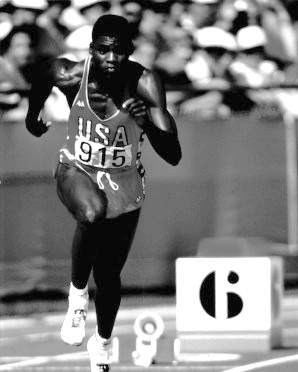
The 1984 Los Angeles Olympics produced many memorable performances, but no athlete defined those Games more completely than Carl Lewis. With speed, grace, and enormous public expectation surrounding him, Lewis entered the Olympic Stadium chasing one of the most famous achievements in track and field history: four gold medals in a single Olympics.
By the end of the Games, he had done it. Lewis won gold in the 100 meters, 200 meters, long jump, and 4×100 meter relay, matching the legendary feat of Jesse Owens at the 1936 Berlin Olympics. For American track and field, it was a defining moment. For Lewis, it was the beginning of one of the greatest Olympic careers ever.
KUHT, CC0, via Wikimedia Commons
The Stage: Los Angeles 1984
The 1984 Summer Olympics returned the Games to the United States for the first time since 1932. Los Angeles delivered a spectacle filled with pageantry, television attention, and a renewed sense of Olympic celebration. For American athletes, competing at home created both excitement and pressure.
Carl Lewis arrived as one of the most discussed athletes in the world. The expectations were enormous because his goal was not simply to win. He wanted to duplicate the four-gold achievement of Jesse Owens, whose 1936 Olympic performance remains one of the most powerful stories in sports history. The Sports Archives Blog has also explored Olympic running legends in The Two Most Famous Runners to Have Won Gold at the Olympic Games.
Gold in the 100 Meters
Lewis began his Olympic campaign in the 100 meters, the event that traditionally crowns the fastest man in the world. In a race defined by explosive acceleration and composure under pressure, Lewis pulled away from the field and won gold.
The victory established the tone for the rest of his Games. He was not overwhelmed by the spotlight. Instead, he seemed to grow stronger under it. The 100 meters gave him his first gold medal and confirmed that the pursuit of four was more than hype.
Dominance in the Long Jump
The long jump was one of Lewis’s signature events, and his dominance there stretched far beyond 1984. In Los Angeles, he captured gold with a controlled performance that demonstrated his rare combination of sprinting speed, timing, and body control.
Some observers criticized the competition because Lewis did not keep jumping aggressively once he had secured the lead. Yet that approach also revealed something important about his strategy. He was managing a historic workload across multiple events, and winning mattered more than spectacle. In the long jump, he did exactly what he came to do.
The 200 Meters and the Owens Comparison
Lewis’s third gold came in the 200 meters, bringing him closer to the comparison that had followed him throughout the Games. Matching Owens was never just a statistical goal. It connected Lewis to a larger Olympic tradition, one built on speed, pressure, and symbolic achievement.
By winning the 200, Lewis proved his range as a sprinter. The event requires both raw speed and the ability to maintain form around the curve and down the straightaway. Lewis handled that challenge with the same smooth efficiency that characterized much of his career.
The Relay Completes History
The final piece came in the 4×100 meter relay. Running as part of the United States team, Lewis helped secure the fourth gold medal that placed him alongside Owens in Olympic history. The relay was more than a team victory. It completed one of the most ambitious Olympic quests ever attempted.
When the United States crossed the line, Lewis had achieved what he had promised. Four events, four gold medals, and a permanent place among the greatest athletes in Olympic history.
Why 1984 Still Defines Carl Lewis
Carl Lewis went on to build an extraordinary Olympic career, eventually winning nine Olympic gold medals and one silver across four Olympic Games. Yet 1984 remains the centerpiece of his public legacy because it introduced him to the world at full scale.
His performance also helped elevate track and field during a period when Olympic sports were becoming increasingly television-driven. Lewis combined athletic excellence with star presence, making sprinting and jumping feel like headline events. For readers interested in the broader appeal of Olympic competition, The Sports Archives Blog’s article on the most popular Summer Olympic sports provides additional context.
A Legacy Beyond One Summer
The 1984 Olympics did not stand alone in Lewis’s career. He later continued winning Olympic gold, especially in the long jump, where his longevity became almost as impressive as his peak. Like other great Olympic track athletes, including Wilma Rudolph, whose story is featured on The Sports Archives Blog in The Story of Wilma Rudolph, Lewis became part of a tradition of runners and jumpers whose achievements reached beyond the track.
His greatness came from more than medals. It came from the ability to perform when the whole world expected history. In Los Angeles, Carl Lewis did not merely win. He fulfilled one of the boldest promises an Olympic athlete could make.
Watch Carl Lewis at the 1984 Olympics
The Golden Image of 1984
Carl Lewis’s 1984 performance remains one of the defining Olympic achievements of the modern era. By matching Jesse Owens’s four-gold standard, he connected two generations of track and field greatness. By continuing to win for more than a decade, he proved that his Los Angeles triumph was not a one-time peak, but the start of a historic career.
Nearly every Olympics produces champions, but only a few athletes come to represent an entire Games. In 1984, Carl Lewis became that athlete, the face of speed, excellence, and golden expectation.


 The Sports Archives Blog