The Sports Archives – ‘True’ Football’s Place in the United States

No one can deny that baseball and American football are the two most popular sports in the United States; they have both been a huge part of the nation’s sociocultural development for over a century, and their respective followings are only climbing over time. Yet, despite how popular each sport may become within the borders of the United States, neither of America’s most followed sporting phenomena are anywhere close to the Top 5 Sports Worldwide. Incontestably, the most popular sport on the planet is football, and, while this may come as a surprise to many Americans, the numbers don’t lie; football’s global following numbers in up to 3.5 billion people – almost 50% of the population! Even as the world progresses on the road to globalization, football (known as soccer in the U.S.) is one subject that has been continually alienated in the United States. Will America ever come to a point where they embrace football for what it is in the rest of the world?

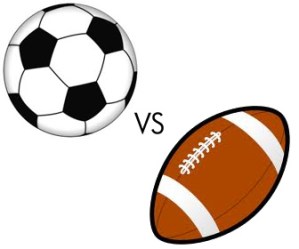
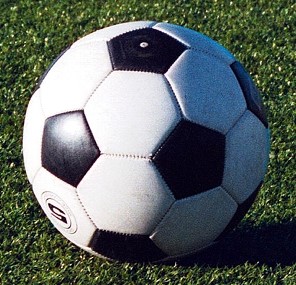
football-vs-soccer-ball

The ball in the top left is acknowledged internationally a traditional “football.” In America, it is called a soccer ball. The ball in the bottom right is an American football. Could one reason that America is not embracing soccer as internationally as the rest of the world be simply because of a name disagreement?

It would by untruthful to say that nothing has changed for soccer over the 100+ years that the dominance of baseball and football has increased its hold on the American public. Perhaps the most prominent influence on soccer interest in the U.S. has been the Fédération Internationale de Football Association, or “FIFA.” Established in 1904, FIFA is an international association dedicated to the large-scale promotion and organization of football. Perhaps their most crowning achievement is the FIFA World Cup, first implemented in 1930, that features a worldwide football competition between competing nations’ football teams. As of 2015, the FIFA World Cup permits 32 national teams to compete, but only 1 can rise to be the victor of the tournament. Through the World Cup itself and videogame channels, FIFA and its organized sporting events have done especially well in increasing the public interest of football in the United States, both directly and indirectly.

What, then, is holding the United States back from accepting soccer the same as most other nations of the world? There is no single answer to this question, but the primary reason that soccer is just not getting anywhere in the U.S. is because of the weight of the sport on American society.  While today soccer is still a perfectly prominent sport following in the U.S., America’s relationship with sporting activities has always been very nationally-focused, contrary to the international focus of most other countries around the world. The National Football League and Major League Baseball are the forerunning organizations involved in bringing sports coverage to the American public, and it is the nature of the United States populace to have more interest and give greater publicity to its national sporting powerhouses. The unfortunate side-effect of this “sports-nationalism” is that the United States Soccer Federation, comparable in role to the MLB and NFL for soccer, is often left in the dust by the media. Much to the dismay of U.S. soccer enthusiasts, American ‘football’ and baseball will remain the top dogs in the United States for the foreseeable future. The sociocultural influence and roots in American history owned by these two national pastimes are too significant to be overcome for now, even by an international phenomenon like football.

USSF_logo

The U.S.S.F. is committed to helping the American public embrace soccer as both an national and international sport.

America’s universal focus on national sports is the most consequential basis for the slow, petering climb of soccer’s popularity, though the cause of most secondary reasons can be traced back to this central point. America’s international soccer team, responsible for representing the United States in the FIFA World Cup every 4 years, is one of notably few areas where the U.S. does not stand out in performance. According to the FIFA/Coca-Cola rankings leaderboard, the United States is not even in the top 10 team positions, coming in more at the center of the pack at 27th place. This does not compare well with the U.S.’s 2nd place rankings for both the World Baseball Classic (baseball’s “world cup”) and the International Federation of American Football’s quadrennial world championships, respectively.

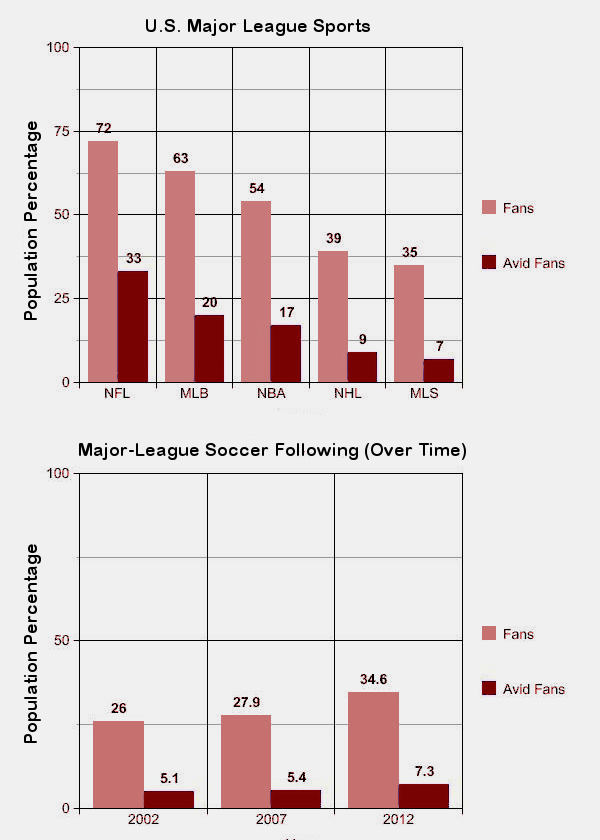
soccer stats

The top graph tracks the popularity of America’s top-tier sporting leagues in 2012 via % of the U.S. population. Major League Soccer is, sadly, still trailing behind the National Hockey League in terms of popularity. However, while this may seem bleak, the bottom graph demonstrates the casual growth rate of MLS followers (also by population percentage). The trend demonstrated is an increase of about 10% over the first 10 years of the 21st Century. Soccer is slowly getting more popular!

Ultimately, the United States is making national progress in embracing football, albeit slowly. Globalization has already taken hold of nearly every industry in existence, manifesting in the international production and distribution of goods, the enormous progression of worldwide communication and technological development over the last few decades, and many similar channels. The gaps between the nations of the world are in a constant state of decay, only becoming smaller over time. This is no different with the sports industry, which means that the rise in the U.S.’s international status in football is inevitable. It is only a question of when this status will fully come to fruition.

Posted in Football, Soccer | Tagged , , , , , | Leave a comment

The Sports Archives – ‘Fair Play’ and the Rules of Hockey

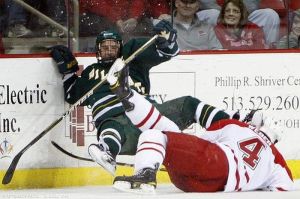
In many ways, hockey is one of the most challenging sports imaginable; its rules are similar to those of soccer or American football, requiring players to maneuver a ball (or, in the case of hockey, a ‘puck’) strategically across an arena and into a designated ‘scoring area’ that is protected by a defensive player. Hockey sets itself apart from other sports in sheer difficulty, requiring players to maintain control of the puck solely with a hooked, wooden stick, all while balancing and gliding across a treacherous plain of ice in unwieldy skates! The fundamental rules of play for soccer, football, and hockey all coordinate exactly how the players achieve the simple goal of moving a scoring object into a respective goal area (for example, in soccer, the players may only use their feet to touch the ball, unless they are reinstating it into play from out of bounds), but the players must be permitted to interact competitively with each other if the object of scoring is to be intercepted or protected by either team. This can be achieved in multiple ways and heavily varies with respect to each sport, but the ‘rules of engagement’ surrounding hockey can be among the most controversial, confusing, and downright inscrutable to even the most attentive spectators.Hockey-Injury1

hockey

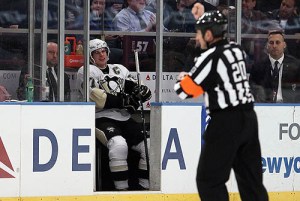
Despite the fact that hockey’s rules of physical contact are highly particular and specific on what or is not allowed, the intuition of even a novice fan is fairly accurate in making judgement calls. Just based on these two images, which example of body checking is more likely to be “legal?”

Most strategies in hockey are simple enough to understand; the flow of each game is fast-paced, similar in fashion to the typical soccer or basketball game. However, the rules regarding physical contact between players is much more similar to football, making hockey a unique hybridization of multiple sporting activities, borrowing select elements from each. Each hockey team consists of a defender titled the ‘goalie’ (named for his sole duty in preventing the puck in play from finding entrance in the team’s goal net), several “defensemen” that head control of the puck when it is on the team’s side of the ice rink, the “center,” who leads the team’s offensive, and the “wings,” which function like wingmen for the center, assisting him in setting up offensive plays and scoring goals. The rules of hockey do not restrict the use of physical contact based on the role of each player, although the offensive players are much more likely to “play rough” than, for instance, the goalie. As with American football, the use of force and physical tactics are effective and, oftentimes, necessary in playing a successful game. However, when sports like football or hockey permit the use of force selectively (the fact that not all types of physical contact are allowed is extremely important) it is not only difficult to make arguments and employ penalties based on excessive or disallowed physical altercation, the fans may be easily misled or confused as to what is allowed “legally.”

There are several prominent terms in hockey that are utilized by experienced players and spectators to categorize or discern specific forms of physical contact from each other. Any type of physical blocking or defensive technique in hockey is as checking, and one of the most common legal forms of this is a body check. The act of body checking is defined as “the use of a player’s body against another player,” and it is permitted only if the player in question was last, or is currently, in possession of the puck. Rules involving body checks are purposefully ambiguous, allowing referees a measurable degree of discretion in deciding on plays. In addition to body checking, other types of permitted defensive blocking include hip-checking, shoulder-checking, and stick checking. Players must be careful, however, that they always check carefully and with ample awareness, lest they get penalized for checking illegally. Some examples of unsafe or illegal checking include “clipping” (the act of knocking an opponent off of his feet by hitting at or below his knees), charging violently at other players, or using the hockey stick as a weapon/deterrent.

penalty_cheat_sheet

With such a variety of signals, each which carries a specific meaning, even hardcore hockey fans may not be entirely versed in every hand signal.

ice-hockey-penalty-box-in-football

The penalty box has done well to reduce opponent-inflicted injuries and promote good sportsmanship in hockey. Many spectators postulate that the concept of a penalty box should be expanded into other sports, but there is no evidence that this will come to fruition anytime soon.

If a player checks illegally or is responsible for the injury of another player of the opposing team, it is likely that he will be penalized by the referee. This process is often quite complicated and consists of multiple steps. First, the referee must halt the match in order to make a public announcement of the infraction committed. This is achieved verbally, or with various hand signals. Once the announcement of the infraction has been made, the referee may then institute a penalty against the offending player and/or his team. Most penalties boil down to a ‘time-out’ – a period of as little as 2 minutes or as great as 10 minutes – in which an incarcerated player is removed from play. The consequence for the individual is not necessarily severe, but any time that a player spends in the penalty box is time in which his team must play ‘shorthanded.’ More serious penalties can result in a player or manager’s permanent ejection from the match, though infractions this severe are far rarer than simple misconducts. Nevertheless, even the most minor of penalties can result in the reckless play of a single individual costing a whole team the game. The significance of penalties and safe blocking in ice hockey highlights the importance of good sportsmanship, fair play, and mindfulness of safety in the grand scope of any sporting activity.

Posted in Hockey | Tagged , , , , , , , | Leave a comment

The Sports Archives – Shock as 15-year-old ‘Hammer’ makes the US Open!

It’s been quite the year for golf. While in 2014, Rory McIlroy was the youngster’s name on everybody’s lips, in 2015, there’s one ankle-biter who has just achieved a hugely impressive feat.

His name is Cole Hammer and he’s just made the US Open. He is just 15 years old.

Cole Hammer

At such a young age, it’s hard to believe that Hammer isn’t the youngest player to ever have made the US Open – that title went to 14-year-old Andy Zhang, of China, back in 2012. However, this has done little to dampen the spirits of Hammer, who told the Dallas Morning News: “This means the world to me. I’ve dreamed about it my whole life. It’s going to be awesome.”

So just how did such a whippersnapper achieve such an impressive feat? Playing at Northwood Club in Dallas, Texas, Hammer was up against a plethora of professional players, among whom there were several PGA Tour winners.

The teenager shot 64-68 in the 36-hole qualifier, finishing alone in second place and staking his claim as one of six players to gain a ticket to the US Open. On Monday 8th June, Hammer managed to birdie four of his five final holes, securing his place as one of the top class golfers worthy of taking part in the tournament.

It’s huge news that will certainly have the bookmakers’ tongues wagging, and many experts at Bookmakers.co.uk are already considering the possibility that they may have another Rory McIlroy on their hands. Back in 2004, the 26-year-old World #1’s father made a modest £200 bet that his son would win the open within 10 years. Sure enough, his bet came in 10 years later, and he managed to pocket a cool £100,000.

This could indeed be something that Cole Hammer’s father should look into. If, at 15, he is already making his way into the US Open, then there is no end to his potential. Of course, it hasn’t come without a lot of hard graft, and the star has certainly done some growing in recent months – both literally and figuratively. In the last 10 months, he has grown four inches, packing on an essential 15 lbs which will be instrumental in giving him the strength he needs to succeed in the US Open.

At just 125 lbs now, he may not be the most heavyweight contender at the Open, but that’s not to say that Hammer won’t pack a punch – let’s just hope he lives up to his name.


Posted in Golf | Tagged , , , , , , , , , | Leave a comment

The Sports Archives – The Art of Pitching

mattmoore

Matt Moore, a left-handed pitcher for the Tampa Bay Rays. The anomalous rarity of left-handedness is one of the ways pitching promotes individuality in baseball.

In baseball, there are 3 fundamental mechanics that absolutely must be present; the ball, beginning in the hands of the defending team, must be thrown to a member of the opposing team; this ‘batter’ must subsequently hit the ball with a long plank of polished wood (or, in some cases, a rod of metal), sending it through the air and into the ‘outfield’; finally, the defending team must secure the infield bases by moving the ball back to the ‘infield’ before the batter can round the bases and make it to home plate – if the batter halts his advance and remains at a base, he is considered ‘safe,’ though it is clearly more rewarding (and, consequently, more risky) to push farther on a single hit. Baseball is defined by these 3 consecutive steps – any other rules added on top of these events are designed to restrict, conform, or even aid play, outlining in greater detail the “rules of engagement.” Yet, despite so many regulations dictating what is appropriate or accepted in-game, baseball still does permit its players to develop their own unique strategies andtechniques, allowing for variety in the individual player as a method of counterbalancing the restrictiveness that is prevalent in overall gameplay. Perhaps the most prominent example of ‘personal freedom’ exhibited on the baseball field comes through the practice of pitching. Though many baseball fans do not know it, the pitcher’s role in a baseball game is often as eloquent and methodical as it is necessary to play; it requires precision, strategy, stamina, and a bold approach to risk-taking.

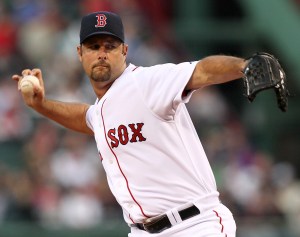
Boston Red Sox starting pitcher Tim Wakefield delivers a knuckleball against the Texas Rangers during the first inning of a MLB baseball game at Fenway Park in Boston Tuesday, April 20, 2010. (AP Photo/Winslow Townson)

Tim Wakefield of the Boston Red Sox. The pitch he is about to deliver is a knuckleball, recognizable by the unique hand position involved with the pitch. Not every pitcher can throw a knuckleball as cleanly and precisely as Tim Wakefield. (AP Photo/Winslow Townson)

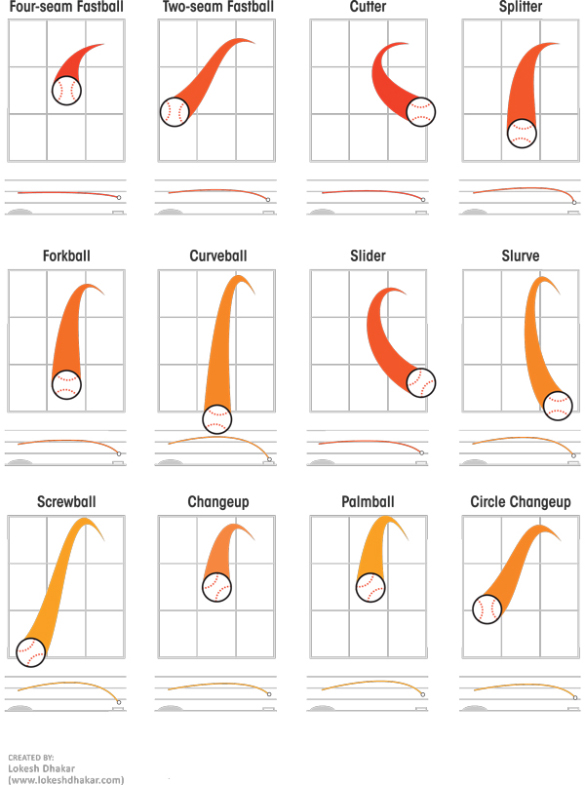
There are many important aspects that define the art of pitching, but one that is often overlooked by the average individual is the variety of pitches. The culture of pitching in baseball has developed a science behind every throw made on the mound, dividing pitches into categories based on facets such as airspeed, trajectory, and throwing technique. Some of the most common types of pitches are the fastball (named for its intention to maximize the speed of the ball while maintaining control of it), the curveball (which causes the ball to ‘bend’ it’s trajectory in midair, often confusing batters), and the changeup (designed to look like a fastball when thrown, but travel much more slowly – again, confusing batters). The individual pitcher usually has one type of pitch that they can employ to greater effectiveness than the others in his/her arsenal, resulting in a famous (or infamous) ‘signature pitch.’ For example, pitchers Steven Strasburg and Randy Johnson are well-remembered by their 4-seam fastballs, with speeds excessing in 100 mph! Some pitching techniques are more difficult to utilize than others, creating ‘anomalies’ – players that stand out in technique or playstyle – that may pose a greater threat to the batting team. One prominent example of a pitching anomaly is former Boston Red Sox pitcher Tim Wakefield, who could throw a very effective knuckleball – one of the rarest types of pitches in Major-League Baseball. The individuality of a pitcher makes batting against him a process of learning for hitters, and even by the bottom of the 9th inning, there are some pitchers that are still able to keep batters guessing!

baseball_pitches

A detailed diagram of common pitches in baseball. Although the mechanics of movement and speed vary between pitches, each of these can be categorized under the 3 more general definitions of fastball, curveball, and changeup, respectively.

Although the defending team’s catcher is officially designated as the “team captain,” it is not uncommon for players or fans to associate the pitcher with the role of a leader. Indeed, every play begins with the pitcher’s action, every pitch thrown has a whole game riding on it, and, though human error is only natural, nearly every run scored by the opposition can be chalked up to a bad pitch in the end. Of all the players in a baseball game, the pitcher has arguably the most control over what truly happens, and playing effectively against a well-trained team is difficult on its own. Imagine, in addition to this, how much more demanding the duty of pitching is, due to its weight on the outcome of the game (and the part it plays in team morale). It cannot be denied, however, that the realm of pitching also comes with its own rewards: a shutout (a game where the opposing team is unable to score a run) is largely chalked up to a pitcher’s endurance throughout the course of 9 innings. Furthermore, a game in which no player is able to score a hit on the pitcher or even touch base (known in ‘baseball lingo’ as a no-hitter and perfect game, respectively) are almost entirely the work of the pitcher alone. As a result, the pitcher is truly set apart from the rest of his team – the “Most Valuable Player.”

SEATTLE - AUGUST 24:  Starting pitcher Randy Johnson #41 of the New York Yankees throws against the Seattle Mariners August 24, 2006 at Safeco Field in Seattle Washington. (Photo by Otto Greule Jr/Getty Images)

Randy Johnson during his time pitching for the New York Yankees. The record for Johnson’s fastest pitch is 102 mph, delivered at the impressive age of 40. (Photo by Otto Greule Jr/Getty Images)


Ultimately, every pitcher is unique in his/her playstyle, and that playstyle is just one more thing in the grand scheme of a baseball game to keep an eye out for on the field.

Posted in Baseball, Other | Tagged , , , , | Leave a comment

The Sports Archives – Soccer: The Beautiful Game!

Soccer is a Beautiful Game!

Soccer is the most popular game in the world with more than 200 countries playing it, out fading any other outdoor sport in terms of popularity in the world. The game Soccer is played between two teams consisting of 11 players on each side (excluding the substitutes). There is a goal post on each side of the field, into which players have to kick soccer balls in order to establish their team on the winning side. Each team has to put soccer balls in the opposite goal posts and the team scoring maximum goals in 90 min time frame (excluding extra time) is declared as winner.  Out of 11 players there is one goalkeeper who’s responsibility is to stop goals or soccer ball going into the goal and is the only person inside the field who can stop the ball with his hand and that too within his penalty area; the rest of the players have to touch the ball with their legs or torso inside the field.

Soccer

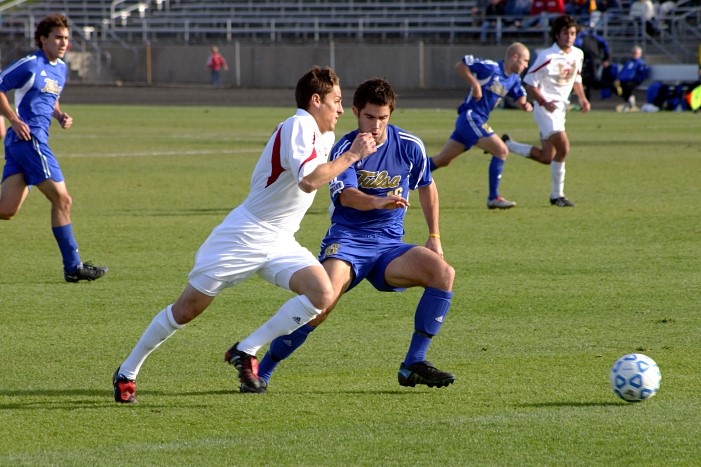
The length of the soccer field for an international match is between 100-110 m and width between 64-75 m the weight of the ball is between 410-450 grams with circumference varying between 27-28 inches.

There are various equipments used in soccer like shin guards to protect the shin as it is most injury prone area in the game , soccer cleats to provide players appropriate momentum for running in every condition and kick the ball in desired manner , goal-keeping gloves so as to ensure that ball is well gripped into the hands of goalkeeper and he suffers minimum injury , player jerseys so as to depict which player is player for which team and generally consist of player name and number with the sponsor’s logo or name .

Soccer balls have a great history as in the ancient times pig’s bladder and human skull were used to kick the not so round ball in the villages ,which eventually with time transformed into today’s soccer ball , the recent being used in 2014 Soccer World Cup named as Adidas Brazuca , which was manufactured in China and Pakistan in huge numbers .

Soccer BallThere are various types of soccer balls used in different types of soccer fields like Premium soccer balls used in international matches being approved by FIFA(International Federation of Football Association) and they undergo various tests for the durability in tough conditions, training soccer balls which are somehow differ in size and air retention capacities, other are turf balls made up in a fashion which are suitable for turfs , then there comes indoor soccer balls which have to differ in construction as they need to rebound less in the inside conditions and have to sustain rebounding from hard walls . To check more about soccer balls visit premiumballs.net

The 2014 Soccer World Cup was held in Brazil which resulted in great economy up-lifting of Brazil as people in large numbers from different parts of the world came to this place to support their teams .This is the power of this game as it is being followed in almost all nations, even in non-soccer playing nations too.

Posted in Soccer | Tagged , , , , , , , , , , | 1 Comment

The Sports Archives – Are You Ready for Some Football?: 5 Best NFL Stadiums!

Football’s heart-pounding action is great on an HDTV, but it’s a hundredfold better when you’re sitting in the stands of an NFL stadium. However, not all stadiums have the same appeal. If you’re in the mood for some awesome football action, try to score tickets to a game at one of these amazing venues.

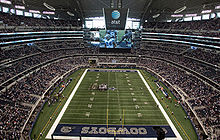
AT&T Stadium

Dallas Cowboys StadiumThe Dallas Cowboys, who boast a glittering history packed with winning seasons and eight Super Bowl appearances, play the field at AT&T Stadium. The stadium itself is the largest in the NFL; it can hold around 100,000 crazy fans for large special events. A huge video display board stretches between the two 20-yard lines. Plus, the pillarless construction means no one gets stuck watching a pole instead of a football game.


Levi’s Stadium

Santa Clara, California, is home to the San Francisco 49ers and the fabulous Levi’s Stadium. The technologically advanced venue has Wi-Fi at speeds that will make your head spin, and you can even use stadium apps that let you easily order that beer and hot dog — or whatever snacks you’re craving. Bad seats are hard to come by here, since the lower deck is large and the upper decks are fairly small.

Even though Levi’s Stadium is the newest venue in the NFL, the team it hosts has a long history that stretches back to the 1940s. In the years since then, the 49ers achieved the feat of winning five Super Bowl championships within just 14 years, between 1981 and 1994. Of course, they are still a blast to watch today.

Sports Authority Field

Denver fans might still be smarting after the Broncos’ humiliating 2014 Super Bowl loss, but Denver finished first in the AFC West from 2011 to 2014 and aims, and they aim to continue their streak. They’re going try to do it at the gorgeous Sports Authority Field, which offers views of the Rocky Mountains. The design of the stadium fits in well with Denver, since the upper decks are curved to look like mountains.

CenturyLink Field

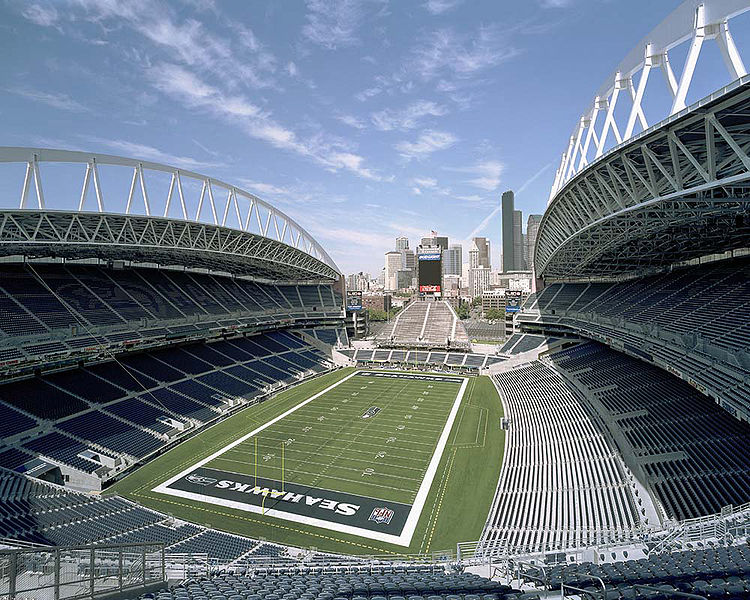
Affectionately known as “The Clink,” CenturyLink Field is where the Seattle Seahawks, along with their Legion of Boom (the Seahawks’ secondary) and the roaring 12s (Seattle’s fans), dominate the opposition. If you’re a football fan who likes things loud, Seattle is one of the best places to live; the Seahawks’ fans make this the noisiest stadium in the NFL. The building itself also has some nice elements: great views of downtown and a cool split-roof design.

The Seahawks might be disappointed after their defeat in Super Bowl 49, but they aim to reclaim their championship title in upcoming seasons.

CenturyLink Field

Soldier Field

Soldier Field, where the Chicago Bears play, was built in 1924, making it the oldest stadium in the NFL. The team once won four titles here in seven years; that, along with decades more of fascinating history, makes this the perfect venue for anyone who wants to get in touch with football’s past. Soldier Field was beautifully renovated in 2003.

If you live and breathe football, you should make it a goal to go on a stadium tour across the nation. You’ll see amazing venues and, better yet, unforgettable plays on the field.

Photo Credits:  Wikipedia Commons

Posted in Football | Tagged , , , , , , , , , , , , , , | Leave a comment

The Sports Archives – 7 Facts about the Seventh-Inning Stretch

Many major sporting events have a break period built into their match schedules. Most competitive team sports, such as football, basketball, and several others, have a ‘half-time’ – an intermission that divides the first and second halves of a match – that allows competing teams to rest briefly before reinitiating play (spectating fans also take this opportunity to refresh themselves in a variety of ways). Baseball also has a distinctive break period that allows players and fans alike to rest and recuperate before the game resumes. However, because baseball games are traditionally divided up into 9 innings, a true ‘half-time’ is neither possible nor viable. As a result, the baseball alternative to half-time takes place immediately after the top-half (and, subsequently, precedes the bottom-half) of the 7th inning. This event is common in nearly all forms of baseball (professional or even recreational) and is aptly-named the “Seventh-Inning Stretch.” An avid follower of Major-League Baseball has a solid understanding of what the Seventh-Inning Stretch is and what it means, but the origin story and various historical trivia behind this event remain unknown to a significant number of baseball fans. Here are 7 exquisite facts about the Seventh-Inning Stretch you probably didn’t know:


  1. Much like the origin of baseball itself, the source of the Seventh-Inning Stretch is disputed. Even today, many of the stories revolving around the foundation of the Seventh-Inning Stretch are primarily speculation and legend passed down through family stories and beliefs, not historical fact. Some stories describe the Seventh-Inning Stretch as originating with a man named Jasper Brennan, a team manager for Manhattan College, who, in order to quell unrest from a large crowd on a hot summer day, ordered everyone up in the midst of the 7th inning to stretch their legs. Other origin tales pit William Howard Taft, the 27th President of the United States (also, incidentally, the heaviest of America’s presidents) as the creator, after he rose from his seat in the 7th inning of a baseball game to stretch his legs, due to discomfort. According to this account, the rest of the crowd rose with President Taft out of respect, and a tradition was born. No set-in-stone origin story of the Seventh-Inning Stretch truly exists.
williamtaft

William H. Taft, 27th President of the United States of America.


  1. The Seventh-Inning Stretch is, more accurately, the first in a recurring series of intermissions that would take place every 7-inning interval. In other words, it is customary, should a baseball game stretch so far into extra innings, to also have a “Fourteenth-Inning Stretch” and even a “Twenty-First-Inning Stretch” in the middle of the 14th and 21st innings, respectively. The longest baseball game in MLB history was an 8-hour, 25-inning match between the Chicago White Sox and the Milwaukee Brewers, so a 28th inning stretch has never been needed in a Major-League Baseball game.
  1. The first published report of a Seventh-Inning Stretch was released in 1869. The account was written by Harry Wright, the Cincinnati Red Stockings’ manager at the time. Wright reported the following in a letter: “The spectators all arise between halves of the seventh inning, extend their legs and arms and sometimes walk about. In so doing they enjoy the relief afforded by relaxation from a longposture upon hard benches.”
  1. The official terminology for the Seventh-Inning Stretch cannot be traced backbeyond the 1920s. As mentioned previously, the event itself could have been founded at some point in the 19th Century, but any recorded instance of the term “Seventh-Inning Stretch” itself being used as a means of describing the event was either unofficial or lost.
  1. In modern baseball games, the song “Take Me Out to the Ball Game” is a common tradition associated with the Seventh-Inning Stretch. Since September 11th, 2001, “God Bless America” has also become prominent as an alternative song.

    harry-wright-portrait

    Harry Wright, manager for the Cincinnati Red Stockings in the year 1869. Wright is the first person known to officially report on the Seventh-Inning Stretch, but he did not define it in those terms. The official name was coined later in baseball history.

  1. In MLB, the Seventh-Inning Stretch has grown in popularity to also occasionally include traditions specific to certain teams. Some examples of this include the Baltimore Orioles, the Texas Rangers, and the Cincinnati Reds playing traditional folksongs. The Toronto Blue Jays are notorious for implementing stretch exercises for both the team’s players and the members of the crowd to the tune of the club’s song, “OK Blue Jays.”
  1. Some of the previously-mentioned team traditions have even spilled over into the 8th To define themselves separately from other baseball teams, the Boston Red Sox, New York Mets, and Los Angeles Dodgers incite each team’s fans to sing along to Neil Diamond’s “Sweet Caroline,” Billy Joel’s “Piano Man,” and Journey’s “Don’t Stop Believing,” respectively. But, if these traditions, which are derived from the Seventh-Inning Stretch, are celebrated in the 8th inning, are they still Seventh-Inning Stretch traditions?


fenway7thstretch

Fans all around Fenway Park stand and move about in observance of the Seventh-Inning Stretch.

While the tradition may not be as heavily praised and promoted as half-time is in other sports, the Seventh-Inning Stretch holds a special place in the hearts and minds of all baseball fans.

Posted in Baseball | Tagged , , , , , | Leave a comment

The Sports Archives – Baseball vs. Football as America’s Pastime


1869-cincinnati-red-stockings

The Cincinnati Red Stockings of 1869 – America’s first professional baseball team. This team’s legacy lives on today through the Boston Red Sox team, the name of which was inspired by the Red Stockings.

Baseball has dominated the sporting industry in the United States since the 19th Century, and is rapidly approaching the 170th anniversary of its first game on American soil. Today, there are 30 baseball stadiums currently operating under Major-League Baseball (MLB) in the United States, with each belonging to one of the 15 American-League or 15 National-League MLB baseball teams. In 1869, the first professional baseball team in the U.S. was founded as an exclusive “club” under the name of the “Cincinnati Red Stockings.” Yet, despite the significance of this unique, popular sport in the history of America’s culture of recreation, baseball’s title as the official pastime in the U.S.A. is perpetually challenged by what is arguably the most popular American sport of the modern day – football. A metaphorical cold war has existed between MLB and the NFL for as long as the two have been competitive, and, unfortunately, whether America’s pastime should be reserved for baseball or American football remains subjective. Indeed, popular opinion will be the deciding factor on who claims the description of America’s pastime, so here are a few important facts about each sport that might help you take a side in the battle over this prestigious title:


  1. Technically, neither sport is an original American invention. The origin of both sports is fairly obscure; initially, baseball was thought to have been invented by a New York man named Abner Doubleday in 1839, but this was later revealed to be a myth. Historically, baseball seems to be an evolution of “cricket” and “rounders,” which are both English sports. The derivation of “baseball” occurred in the early 19th Century with the help of a man named Alexander Cartwright. Similarly, American football was
    rugbyworldcup

    The rugby ball used in the World Cup of 2015. It is slightly rounder than the traditional NFL football, but is functionally the same otherwise.

    derived from similar games in England (where it is commonly referred to as “rugby” today). Like the changes to baseball imposed by Cartwright, modern American football resulted from rule alterations courtesy of college graduate Walter Camp. Overall, neither sport is entirely American, though, if the argument were to be made, baseball is slightly more original based on a greater deviance from its root sports.


  1. While both sports are athletically rooted, baseball is focused more on technique, whereas football popularizes brute strength and strategy. In baseball, the defending team needs to coordinate fielders to prevent batters from rounding the bases and reaching home plate. This is achieved by gaining control of the ball (once it is struck by the batter from home plate) and moving the ball across the field to the base-running area. A player that gains possession of the ball whilst guarding a base can tag a player “out,” and 3 outs result in the teams swapping play objectives. Thus, as the main object of both teams is to manipulate the position of the ball while simultaneously keeping as little contact with it as possible, baseball is a very technical sport predicated on clean, efficient play. In contrast, football consists of a race against the clock, in which both teams attempt to coordinate ground-gaining plays to move the ball into the opponent’s goal area at the end of the field. While the team in possession of the ball uses blocking, throwing, and running tactics to move their ball, the defenders ensure the quarterback (the player chiefly responsible for the ball’s movement) gains as little ground as possible. Both sports embody significant American values – competitive spirit, teamwork, athletic prowess – but which specific trait is more defining for the United States as a whole – skill or strategy?


  1. Public opinion in the U.S. favors the National Football League. Perhaps the most significant argument in favor of football over baseball is the numbers as they exist in modern-day America. In the 2011-2012 fiscal year, the combined television contracts for the NHL, MLB, and the NBA barely amounted to 1/3 of that of the NFL, with marketing expenses numbering at over $3 billion. The average market value of the NFL’s teams exceeded $1.1 billion for the same year – close to double those of MLB, and, most importantly, the NFL brought in an additional $1.8 billion in sales revenue over MLB’s 7.7. While in some areas, the NFL does not come out on top by such a significant margin, the numbers are definitely stacked in football’s favor. While the NFL and MLB are only the top divisions for each respective sport in the U.S., they speak loudest on public opinion. MLB, despite its lagging behind the NFL, still dominates 2nd place in nearly all statistics when compared with other members of the National Sports Leagues of America.revenuesports

    averagevalueofsportsteams

    Top: Total Revenues for each League in the 2011-2012 year. It favors the NFL by a considerable margin, with MLB chasing it in 2nd place. Bottom: The Market Value of Teams in each League (measured via salary totals, popularity/demand, etc.) NFL once again leads MLB, with nearly double a sum market value for the teams in the league and negligible difference in the number of teams (MLB’s 30 to NFL’s 32).


Baseball is preached as America’s pastime by highly-accredited sources across the nation, but the numbers have shown favoritism towards football in recent years. Is the public opinion changing? Will baseball be overtaken by a large margin by football in the public eye over the course of just 10 more years of American sports? The answer to this question may be largely influenced by you. Consider these 3 important facts carefully and take a stand! By your own opinion, the answer to the question “What is America’s Pastime?” may very well be set-in-stone someday!

Posted in Baseball, Football | Tagged , , , , , , | Leave a comment

The Sports Archives – Paragliding- At least Once In A Lifetime!

Millions of people, mostly kids would have a part of their life emerged in the fantasy world of Peter Pan, Harry Potter, magics, and miracles. Trying to fly among the sparkling stars painted on the canvas of the night, just like peter pan did in the story. I still have that urge of flying in the blue sky with that broom of Harry Potter. However,  I don’t have any idea, how J. M. Barrie and  J.K. Rowling made their book characters fly that high.

paragliding

Alas!  We don’t have those magic chants and potions. Still, we can fly high with the artificial wings called as paramotors.

Paragliding is an adventure that you should do at least once in your life. It’s awesome to feel the air under your feet! You are going to glide like birds in the sky, gathering some of the most amazing views of your dear planet, Earth. The thrill, and the rush of adrenaline inside the veins, every bit of it is exciting. All you need is a proper training before heading towards this lifetime experience.

paragliding

 For Beginners – Thrill as Well as Fun

Before experiencing it myself, I used to think it was a sport of maniacs. But the real experience has something else to say –

Since my first date with the fierce wind, Paragliding has been one of my favourite sports. It is exciting, challenging, funny, and most importantly, you feel free out there. All you need is paramotor training and proper equipment to start with Paragliding. If you are doing for a short time fun then you can rely on the Pilot. However,  for achieving the perfection, you need to be serious. Start your training today with the best instructor and learn to play with the gliders in all the atmospheric conditions.

There is nothing like danger and fear in Paragliding. All these rumors come from people who have not experienced the fun of this sport. Thrill can’t be considered as a danger. You are safely tied with at least 30 strings that is connected to the wing, and believe me, they are strong enough to carry your weight.

Paragliding Pilots – You are in Safe Hands

It is not like driving on the road or a train driving. Paraglider pilot possesses an extraordinary amount of control. They are trained to have a subtle control on the speed and the direction. The only thing that can come in between their experience and expertise is the heights and weather condition. So, you just have to enjoy your sport, leave the rest to the pilot.

paragliding

The First Flight – Go Courageously!

Reached the destination from where you need to glide? For the first timers the hill slope is a little low as a comparison to experts. You need to take nursery steps at your inflation phase, the wings will start filling with air. Within a few minute pressure will swiftly roll over you with a feeling of excitements and hormones rushing inside your skin.

Now, your toes can’t feel the earth’s surface and you are up in the air. This is it, you are in the open air among the birds, and chilly wind. Open up your heart and feel free to take a gulp of the fierce wind. You have wings and you are dwelling like birds. Think about your childhood fantasy of flying, which is no more a fantasy. It doesn’t matter whether they used a wand or broom to fly, because you too can fly now. Yell your lung out –

 Yes I have made it!

Do Not Limit Yourself

Paragliding can be considered among some of the biggest addictions. Once you are in it, the urge of flying increases day by day. If you are fascinated by flying then do not stop yourself, go for it. You can get a proper paramotor training from experts. Once you are trained, there is no boundary of time and weather. Usually a normal Paragliding takes 25-30 minutes, depending on the weather condition, but there is no such boundary if you are a trained pilot. You can have the amazing view of the whole city through Paragliding. The maximum record of Paragliding has been 502.9 km, reach out to break it.

I personally feel that Paragliding is comfortable as well as exciting. Unlike Parachuting and rappelling, its gears are more comfortable and you don’t need to hang yourself amidst uncountable strings. The modern harness is a lot cozier, you just need to make yourself comfortable in it. So, what else do you need?  It is comfortable, safe and above all it is giving you a chance to live your fantasies.

paragliding

So, take an aerial view of your beautiful city with Paragliding.

Author Bio

Lisa Coffey (°1988, United States) is a Freelance Content Writer, who writes in many fields. With a conceptual approach, Coffey tries to approach a wide scale of subjects in a multi-layered way, likes to involve the viewer in a way that is sometimes physical and believes in the idea of function following form in a work.

Her creative work directly responds to the surrounding environment and she utilizes her everyday experiences from travelling as well which gives a starting point to write. Often these are framed instances that would go unnoticed in their original context. She is currently associated with adventureflightsppg

Posted in Other | Tagged , , , , , , , , , , , , | Leave a comment

The Sports Archives – Building a Better Person

The modernization of sports has seen the inclusion of many new types of activities into the sports genre, all of which are gaining considerable popularity. Some of these sports come with an artistic focus, such as dance, while others utilize brand-new technologies in a competitive fashion, as is the case with major-league video gaming. As a society’s culture spreads, the fundamental nature of sporting activities is changing as well, and in many cases, the competition is no longer defined as the foremost objective. In some cases, the would-be “side-effect” of rigorous sporting activities instead surpasses the competition as the primary focus of the sport. Such is the case with Bodybuilding.

arnold-flexing

Arnold Schwarzenegger performing a “Front Double Biceps” pose.

A competitive test of strength can be considered one of the most original forms of sporting activity in the world. As a result, it is not entirely inaccurate to suggest that Bodybuilding is one of the earliest sports in history. It is important, however, to make a distinction between modern Bodybuilding and the feats of strength popular in Ancient Greece and Egypt. Beginning in the late-1800s, Modern Bodybuilding (also widely known as “Western Bodybuilding”) began in 19th Century Europe, with “strongmen” challenging each other to tests of strength among the public community. In the United States, Bodybuilding reemerged from a brief intermission when gymnastics simultaneously experienced a surge in popularity. Rather than a battle to display the rawest strength and power, Modern Bodybuilding concentrates more on a refined, balanced physique. Through the 1970’s, Bodybuilding continued to gain traction in the West, popularized by celebrity powerhouses such as Arnold Schwarzenegger and Lou Ferrigno. The year 1981 would see the formation of the National Physique Committee, headed by Jim Manion who, at the time, had just resigned from his position as chairman of the American Athletics Union Physique Committee. The NPC would continue to gain a following, becoming the forefront Bodybuilding committee in America that it is today.

Continue reading

Posted in Bodybuilding, Other | Tagged , , , | Leave a comment