The Sports Archives Greatest Moments – Boxing’s Chuck “Rocky Balboa” Wepner

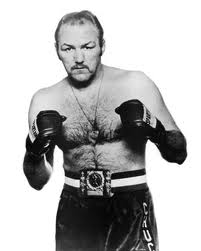
Former heavyweight boxer and US Marine, Chuck Wepner, had his 15 minutes of fame back in 1975.  Actually, to put it more accurate, it wasn’t 15 minutes, it was 15 rounds of fame.

1975 was the year that Wepner, also known as the Bayonne Brawler and Bayonne Bleeder,  fought heavyweight boxer Muhammad Ali and went 15 rounds with the champion.  Despite cuts above both eyes and a broken nose, Wepner was able to withstand Ali’s onslaught until 19 seconds left in the 15th round at which time Wepner finally hit the mat.

Sylvester Stallone modeled his character, Rocky Balboa, of the movie “Rocky” after Wepner and his bout with Ali.  The movie was very successful and sequels to “Rocky” were later produced.

Ali called his bout with Wepner, one of the toughest fights in his career!

Chuck Wepner

Chuck Wepner

Posted in Boxing | Tagged , , , , , , , | Leave a comment

The Sports Archives History Lesson – Baseball’s “The Natural”

We all remember the movie “The Natural” with Robert Redford portraying Roy Hobbs, the fictional baseball player who played for a team called the New York Knights.

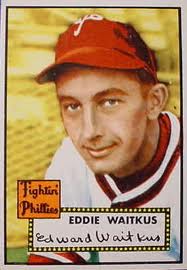
Did you ever wonder if there was any truth in the novel by Bernard Malamud? The story was loosely based on the life of Eddie Waitkus who played for the 1950 Philadelphia Phillies. He was known at the time as a member of the Phillies’ “Whiz Kids”.

Roy Hobbs in “The Natural” was shot by an obsessed fan but returns to play and lead the Knights. Eddie Waitkus was also shot by an obsessed fan, Ruth Steinhagen, who is quoted as saying “For two years you have been bothering me and now you are going to die.”

Waitkus did not die and was named Comeback Player of the Year helping to lead the Phillies to the pennant.  Waitkus, did however, suffer from post-traumatic stress disorder because of the shooting, which impacted his career and his marriage.

Eddie Waitkus

Ruth Steinhagen

Ruth Steinhagen - woman who shot Eddie Waitkus

Posted in Baseball | Tagged , , , , , , , , | 4 Comments

The Sports Archives History Lesson – Model for Heisman Trophy

Frank Eliscu is the sculptor of the Downtown Athletic Club Trophy, now better known as the Heisman Trophy.

When Eliscu was looking for a model for his cherished trophy, he didn’t have to look far. He asked a former high school classmate of his, Ed Smith, who at the time was playing football for New York University, to be the model for a project he was working on. Eliscu finished the sculpture in 1935.

It wasn’t until 1982 that Ed Smith was informed that he was the model used for the sculpting of the famed Heisman Trophy! Three years later he was awarded one of his own by the Downtown Athletic Club Trophy.

Heisman Trophy

Heisman Trophy

Posted in College Football, Football | Tagged , , , | 3 Comments

The Sports Archives History Lesson – Wide World of Sports “Agony of Defeat”

Do you remember the theme song of ABC’s “Wide World of Sports” and the video of the tragic ski jump that narrator Jim Mckay announced as the ‘Agony of Defeat’?

Ever wonder who that jumper was and where the event occurred?

It was during the 1970 World Ski Flying Championships in Oberstdorf, West Germany that Vinko Bogataj from Yugloslavia, attempted a ski jump that was so tragic, it made it to the Wide World of Sports Highlight video in the worst way!

Wide World of Sports - Agony of Defeat

Wide World of Sports - Agony of Defeat

Posted in Olympics, Other | Tagged , , , , | Leave a comment

The Sports Archives History Lesson – Football’s Taunting Rule

Excessive gyrations, spiking the football, and wild celebrations after scoring a touchdown were considered unsportsmanlike by the NFL. Consequently,  the league decided to install the “Taunting Rule” which prohibited teams and players to exhibit this type of behavior.

It is said that the sack dances by New York JetsMark Gastineau (one of the key members of the Jets’ “New York Sack Exchange” along with teammate Joe Klecko during the 1980s),  performed after his dramatic quarterback sacks, were what prompted the league to establish the “Taunting Rule”!

Mark Gastineau Sack Dance

Posted in Football | Tagged , , , , , , | 2 Comments

The Sports Archives History Lesson – Baseball Umpire’s Hand Signals

In the late 19th century there was a DEAF baseball player in the Major Leagues named Dummy Hoy who was unable to hear the umpire calls of pitched balls, strikes and outs.

This paved the way for the use of hand signals by baseball umpires to accompany their calling of the play. It probably also aided players out in the field who could not hear the call, that is before electronic scoreboards were used!

By the way, Dummy Hoy was one of the greatest players of the game and should have been elected to the Hall of Fame.

Read all about Dummy Hoy here.

Dummy Hoy Baseball Card

Dummy Hoy Baseball Card

Posted in Baseball | Tagged , , , , , | 2 Comments

The Sports Archives History Lesson – Hockey’s Multi-Goal Power Play

Prior to 1956 in the NHL, a player taking a penalty was required to ‘do’ his time regardless of how many goals the opposing team scored while the player was in the box.

Teams of the 1940’s and 1950’s, such as the Montreal Canadians and Detroit Red Wings loved the power play. They would send out players like Maurice “The Rocket” Richard and Gordie Howe and they would excel on the power play, scoring many times before the penalty was over.

The league thought this to be unfair and mandated that the minor penalty expire if the opposing team scores a goal in the duration.


Maurice Richard

Maurice Richard


Posted in Hockey | Tagged , , , , , , , | 1 Comment

The Sports Archives History Lesson – Baseball’s Infield Fly Rule

Tommy McCarthy, selected to be a member of Baseball’s Hall of Fame in 1946, is credited with establishing baseball’s Infield Fly Rule. When there are fewer than two outs and with base runners on first and second McCarthy would purposely miss an infield fly ball that was easily playable to start a double play. The Infield Fly Rule was established to prohibit this practice.

Tommy McCarthy, who played for the Boston Beaneaters and Philadelphia Quakers in the late 19th century is also known for being instrumental in establishing baseball’s hit-and-run play.

Tommy McCarthy

Posted in Baseball | Tagged , , , , , | Leave a comment

The Sports Archives Greatest Moments – 2010 SF Giants win World Series!

The San Francisco Giants have finally proved that they are a team to be reckoned with. Having never won the World Series while in San Francisco, the last time the Giants saw the trophy was when they were based out of New York in 1954.

The 1954 NY Giants team was composed of superstars, names such as Willie Mays, Dusty Rhodes and Hank Thompson. In comparison, this SF Giants team had a lineup of regulars in Cody Ross, Pat Burrell and Aaron Rowland.

Nevertheless, the SF Giants downed a high potent Texas Rangers offense 4 games to 1, out-dueling Rangers ace Cliff Lee and the rest of the Rangers pitching staff.

The time has finally come, 50 plus years later, for the ‘new’ Giants of San Francisco to separate from the ‘old’ Giants of New York. San Francisco can now say they have a winner of their own.

Say Hey Willie!

Posted in Baseball | Tagged , , , , , , , , , | Leave a comment

The Sports Archives History Lesson – Baseball’s Batting Donut

The batting “donut” is a heavy circular lead weight encased in rubber which is slid up to the barrel of the baseball bat. Before this invention, players waiting in the on-deck circle would swing 2 or 3 bats at a time to loosen up. Then, the bat of choice would feel lighter and easier to swing when it was time to step up to the plate.

This invention is credited to Elston Howard, a catcher who played with the New York Yankees and Boston Red Sox from 1955 to 1968. Howard is also noted for being the first to use the index and pinky fingers to communicate to the other fielders that there were two outs.

The Yankees retired Howard’s jersey number 32 in 1984.

Posted in Baseball | Tagged , , , , , | 1 Comment