The Sports Archives – Boxing: A Brief History

Ever since the first angry man struck another with his fist, humans have been aware of the power of the punch. Being a perfectly designed bony, yet flat, surface, and driven by the momentum of a whole body, the fist has been the preferred method of doling out punishment since deep into pre-history. It is no wonder then that in every single culture throughout the world, the test of a man’s mettle would be his ability to fight off an enemy. Boxing has its roots somewhere in this deep past, when men (or women), even friends, would challenge each other to non-lethal combat as an exercise for true warfare. Paintings have been found on walls and pottery from Sumer (3rd mill. BC) and Egypt (2nd mill. BC) which depict people fist-fighting; some even include spectators.

Most of what we know about ancient boxing comes from the Greeks, however. Homer’s Iliad, dated to the 8th century BC, includes perhaps the oldest record of a boxing match ever found. The competition perhaps reached its full acceptance as a sport when it was included in the Greek Olympics of 688 BC. Competitors in these fights would train much as modern boxers do, using leather knuckle straps and punching bags. The Olympics, a festival dedicated to Zeus, was the first major sporting spectacle of the ancient world, beginning in 776 BC. In 393 AD, however, it was permanently canceled (in its ancient form at least) by the Roman emperor Theodosius I, who sought to remove all vestiges of pagan religion in the Christianized empire. From this time on, little is known about boxing as a formal sporting event. The records we do have come from Italy and ancient Russia where recreational fist-fighting was a fairly common type of game, but there is no substantial evidence that the fights included an audience.

Boxing re-emerged in the West as the practice of wearing swords waned in favor of an interest in “fencing with fists.” The renewed interest in martial arts stirred up a flurry of fist-fights in England (where the sport was often called “prizefighting”). One of these fights was the first to make the papers when it was detailed in the pages of the London Protestant Mercury in 1681. Apparently a Duke organized a fight between his butler and his butcher. Does it even need to be said who won? The butcher!

By 1719, England had a national champ, James Figg, who held the title for 11 years! As the chaotic sport grew, and several men died brutally in the ring, a champion fighter named Jack Broughton organized a new set of rules, such as: the 30-second rule, no hitting below the belt, and no hitting a man while he’s down. These rules were codified in the London Prize Ring Rules (1838), and then supplanted by the Marquess of Queensberry Rules (1867) which were the first to mention gloves at all! Boxing as we know it today emerged from these humble, but ancient, beginnings and still rests on the rules developed by the Marquess of Queensberry.

Author Bio: Ethan writes on behalf of BoxFit, a UK-based boxing gear supply, and home of Rival Boxing Equipment.

Posted: 06/29/2011

Posted in Boxing | Tagged , , , , , , , , , | 4 Comments

The Sports Archives – FIFA Women’s World Cup Fun Facts and Memories

The 2011 FIFA Women’s World Cup tournament is held in Germany and began on June 26, 2011 with host team and defending World Cup champion Germany winning it’s first game with a 2-1 score over Canada.

Here are some interesting facts of past FIFA Women’s World Cup tournaments.

  • The first FIFA Women’s World Cup tournament held in 1991 was named the Women’s World Championship and was established 61 years later after the first FIFA men’s world cup in 1930.
  • At present, Norway is the only team other than the United States and Germany to win the Women’s World Cup.
  • Brazil, Germany, Japan, Nigeria, Norway and the United States will have participated in all six Women’s World Cup tournaments to date.
  • At present, Germany is the only team to win consecutive Women’s World Cup tournaments.
  • The 1999 Women’s World Cup final was held at the Rose Bowl in Pasadena, California where an attendance of 90,185 set a world record for a women’s sporting event.
  • The 2003 Women’s World Cup venue was moved from China to the United Stated due to the SARS epidemic in China.  China still automatically qualified in 2003 and also went on to host the 2007 tournament which was won by Germany.
  • At present, the leading Women’s World Cup goal scorer is Birgit Prinz of Germany with 14 goals.  Second is Michelle Akers of the United States with 12.
  • The 2015 Women’s World Cup will be hosted by Canada and will feature 8 more participating teams for a total 24 and 20 more games played for a total 52.
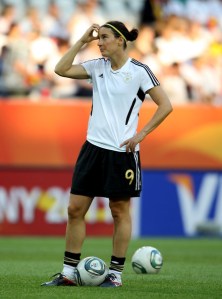
Birgit Prinz

Birgit Prinz is current Women's World Cup goal scoring leader.

Posted: 06/27/2011

Posted in Soccer | Tagged , , , , , , , , , , , , , , , , , | 1 Comment

The Sports Archives – Funny Sports Pictures – Series 3

More funny pictures from The Sports Archives!

Sumo Wrestler Ski Jumping

I hate these new training programs!

Uh Oh... umm.... stick around for more championship fencing after these messages!

Uh Oh... umm.... stick around for more championship fencing after these messages!

Breaking News...it seems the Moon land rover was just stolen by some alien life force!

Breaking News...it seems the Moon land rover was just stolen by some alien life force!

OR

Junior...you can stop mowing the lawn now

Junior...you can stop mowing the lawn now!

Posted: 06/22/2011

Posted in Olympics, Other | Tagged , , , , , , | 1 Comment

The Sports Archives – 2011 FIFA Women’s World Cup

The 2011 FIFA Women’s World Cup tournament commences on June 26, 2011 in Germany.  The tournament has been held only 5 times previously with the United States Women’s team winning the first ever in 1991, followed by Norway and then the United States again in 1999.  The German Women’s team has won the last two world cup championships and the only team to date to win consecutively.  They will try to three-peat playing in their own country.

The 15 other teams hoping to dethrone Germany are Japan, the United States, Brazil, Australia, North Korea, Canada, Mexico, Nigeria, Equatorial Guinea, New Zealand, Colombia, England, France, Sweden and Norway.  This is the first Women’s World Cup tournament for the countries of Columbia and Equatorial Guinea.  The US had to defeat Italy in a playoff series to qualify in this year’s tournament.

Some of the players to watch for in this year’s tournament are Abby Wambach and Heather O’Reilly from the United States; Birgit Prinz and Kerstini Stegemann from Germany; Marta from Brazil; Kelly Smith from England; Sandrine Soubeyrand from France; Therese “Terre” Sjögran from Sweden; and Solveig Gulbrandsen from Norway.

This year’s tournament should prove exciting and competitive with the US grouped with Sweden; Brazil with Norway; and Germany and France battling it out in Group A.

2011 FIFA Women's World Cup

2011 FIFA Women's World Cup

Posted: 06/18/2011

Posted in Soccer | Tagged , , , , , , , , , , , , , , , , , , , , , , , , , , | Leave a comment

The Sports Archives – The Championships, Wimbledon – 5 World Records

Special Thanks to Author:  Jonathan Piggins

The Championships, Wimbledon returns to the All England Lawn Tennis Club this June to see the greatest tennis stars in the world battle it out for the most coveted title in tennis. In preparation for the event, and to remind us all of the amazing ability and commitment of the players that feature at Wimbledon, we have compiled a list of the greatest World Records currently set at Wimbledon – enjoy!

  • Oldest Grand Slam tournamentFans know it as the most prestigious tennis tournament world but did you know it is also the oldest? The All England Lawn Tennis and Croquet Club (the home of the Wimbledon tennis tournament) had its first lawn tennis championship in the spring of 1877 – the “Gentlemen’s Singles”. This was a year or two after “lawn tennis” (a form of tennis that the modern game is based on) was first created by Walter Clopton Wingfield. A new set of codes were drawn up specifically for the event with many of the rules remaining in today’s tennis.
  • Longest Tennis Match2010 saw a bevy of World Records being made at Wimbledon and many of them were the result of one match.When John Isner (USA) and Nicolas Mahut (FR) met on 22 June 2010 as part of the first round of the Wimbledon Championship it was unlikely that either would have foreseen the epic match that lay ahead. It lasted a whopping 11 hours 5 mins of play over three days. It had broken the record for the longest ever tennis match by the 2nd day and on both 22nd and 23rd June play was suspended due to darkness. The match currently holds a whole host of other world records including:

    The most aces served by an individual player
    John Isner currently holds the honour of serving 113 aces – the highest number in any Grand Slam tennis match.

    Longest Match by Time and games
    The match took 11 hours 5 minutes of playing time requiring 183 games to finish.

    Longest set by time and games
    The 5th set took 8 hours and 11 minutes – 138 games were played.

    Longest Play and most number of games in a Single Day
    The first 118 games of the 5th set played on the 23rd June 2010 lasted 7 hours 6 minutes.

  • Lowest Ranked Player to win a Grand SlamIn 2001 Croatian Goran Ivanisevic won his first Wimbledon Grand Slam title in an impressive match with Australian Pat Rafter. What is more impressive is that Ivanisevic was ranked 125th at the time and entered the tournament as a wild card. This makes Ivanisevic the lowest ranked player to win a Grand Slam title and Wimbledon’s first (and only) wildcard champion. He was previously a Wimbledon runner-up 3 times (1992, 1994 and 1998). He also holds the current record for the most aces in a tennis tournament with 212 aces made at his 2001 Wimbledon appearance.
  • Longest grand slam tennis match (doubles)Not content with the longest ever tennis match, Wimbledon also holds the record for the longest ever grand slam doubles tennis match thanks to Daniel Nestor (Canada), Mark Knowles (Bahamas), Simon Aspelin (Sweden) and Todd Perry (Australia). On 4-5 July 2006 the Wimbledon quarterfinal match lasted 6 hours and 9 minutes seeing Knowles and Nestor beat Aspelin and Perry 5-7, 6-3, 6-7, 6-3, 23-21.
  • Longest Grand Slam Final Set by Games2009 saw Roger Federer and Andy Roddick battle it out in what was to be the longest tennis match in a Wimbledon final by number of games. Despite Federer taking the lead by the fourth set, Roddick managed to break Federer’s serve by the fourth game leading to Roddick winning the fourth set forcing the match into a fifth. What transpired was the longest 5th set in a grand slam final with Federer finally breaking Roddick’s serve to win the game 5-7, 7-6, 7-6, 3-6, 16-14.

Wimbledon 2011 is shaping up to be an extremely exciting tournament with hopefully the chance of a few more World Records being made at this year’s championships. Whilst tickets are currently allocated through the Public Ballot, Wimbledon hospitality tickets are still an option for fans looking to get into this year’s tournament.

Jonathan is a huge sports fan and loves writing about cricket, tennis and football. He is currently writing on behalf of Keith Prowse – the UK’s number one sports hospitality provider. Keith Prowse has more official appointments than any other hospitality provider, including official Wimbledon 2011 Hospitality.

Posted: 06/15/2011

Posted in Tennis | Tagged , , , , , , , , , , , , , , , , , , , , | 1 Comment

The Sports Archives – Funny Sports Pictures – Series 2

More funny pictures from The Sports Archives!

Soccer Dentist

"I'm a dentist in the off-season...which tooth is it?"


Dog Water Skiing

"It's OK...before I became an instructor...I had to hold on too."


Where's Waldo

Where's Waldo?


Posted: 06/09/2011

Posted in Olympics, Other, Soccer | Tagged , , , , , , | 2 Comments

The Sports Archives – 5 Facts about the French Open!

Special Thanks to Author:  Jonathan Piggins

The 2011 Roland Garros French Open is seeing some fantastic tennis – from Rafael Nadal’s fantastic form to Li Na’s historic entry as the first ever Chinese player to reach the French Open Final. As the French Open reaches an exciting conclusion we share a few interesting facts about the world’s most televised tennis tournament.

Fact 1 – It’s not actually called the “French Open”…
In fact to the French it has always been known as Les internationaux de France de Roland-Garros or Tournoi de Roland-Garros – The Roland Garros International tournament. It wasn’t always an international tournament either – it was a national tournament open only to members of French tennis clubs when it was first created back in 1891. It was opened up to international amateurs in 1925.

Fact 2 – Stade de Roland Garros was built to defend
The Stade de Roland Garros – the home of the French open – was constructed in the 1928 to host France’s first defence of the Davis cup after they won it on American soil the previous year. It is named after a famous French aviator (first to fly over the Mediterranean Sea) and World War I hero Roland Garros who was passionate about tennis.

Fact 3 – It’s here to stay… in Paris
The French Open has been held in Paris every year since 1891, except from 1939-1945, when it was canceled because of World War II. There have been discussions about moving the tournament to another venue as part of the rejuvenation project for the game however, it is certain that the Tournament will be played in Paris.

Fact 4 – Its not the luckiest venue for French players…
Only two men and three women from France have ever won a single’s title at the French Open – the last was Mary Pierce in 2000.

Fact 5 – It is the most difficult Tournament of the Grand Slams
The French Open is the only Grand Slam tournament played on clay courts – balls fly higher and slower meaning players require great stamina to keep up with play. Due to the slow surface, French Open is the most physically demanding tennis tournament in the world. Clay courts also take away some of the advantages of big serves and serve-and-volleyers, which makes it hard for serve-based players to dominate on this surface. Some extremely talented players with the game’s best serves (*cough* Roddick *cough*) have failed to win at the French Open for this reason. There is also no tiebreak in the final set at French Open in Men’s Singles matches.

Bonus – Fact 6 – Nadal dominates
The World’s top player has found huge success on this notoriously difficult surface. Last year’s champion, Rafa Nadal returns to the French Open with a very impressive track record – of the 39 matches he has played at the tournament he has won 38 – he has only ever lost 1 match at the French Open. What’s more, Nadal has never played a five-set match at the tournament.

We await the results of this tournament in great trepidation (especially seeing as we are rooting for GB’s Andy Murray!). With Wimbledon tickets being picked up in high demand this year is set to be a fantastic year for tennis fans everywhere!

Keith Prowse is the UK’s number one hospitality provider with a heritage in entertainment and ticketing for over 200 years. Keith Prowse has more official appointments than any other hospitality provider, including official tennis hospitality. Visit Keithprowse.co.uk for more information on Wimbledon 2011 hospitality tickets.

Posted: 06/07/2011

Posted in Tennis | Tagged , , , , , , , , , , , | Leave a comment

The Sports Archives – FIFA Women’s World Cup – Mia Hamm

Mariel Margaret Hamm, better known as Mia Hamm, was born on March 17, 1972 in Selma, Alabama.  She played forward many years for the United States women’s national soccer team, and scored more international goals (158) than any other player, male or female, in the history of the game.

Mia Hamm - US Women's Soccer Legend

Mia Hamm - US Women's Soccer Legend

Hamm is one of the most famous female athletes in the world, an icon of women’s sports, and an inspiration and role model to scores of sports-minded young girls.  One of the first to benefit from gender equality rights after Title IX was passed; she received college scholarships, endorsements and training opportunities in her climb to becoming a top superstar.  Mia Hamm won the women’s FIFA World Player of the Year award in the first two years that it was established (2001 and 2002).  She made Pelé’s list of one of FIFA’s 125 best living players and The Washington Post columnist Michael Wilbon called Hamm, “Perhaps the most important athlete of the last 15 years”.

Mia enrolled in the University of North Carolina at Chapel Hill and helped lead the Tar Heels to four NCAA women’s championships in five years.  In 95 games that Mia played, the Tar Heels only lost one.  She was All-American and Atlantic Coast Conference player of the year for her last three years and also won ACC Female Athlete of the Year in 1993 and 1994.  Mia also had a stint with the Sweetwater Red Devils in National City, California.

In 1991, at age 19, Hamm became the youngest American woman to win a World Cup championship when the US women’s national team won the FIFA Women’s World Cup for the first time.  Also, Mia played for the American National college team in the 1993 Summer Universiade losing to China, but gaining the silver medal.  She was leading scorer with 6 goals and graduated college with all-conference records of 103 goals, 72 assists and 278 total points.

In a game against Brazil on May 22, 1999, in Orlando, Florida, Hamm broke the all-time international goal record with her 158th goal.  Also in 1999, Nike named the largest building on their corporate campus after Hamm, and in that same year she helped lead the Women’s national team to it’s second FIFA Women’s World Cup victory final, a match that surpassed the Atlanta Olympic final as the most-attended women’s sports event, with over 90,000 filling the Rose Bowl.

She helped lead Team USA to a gold medal at the 2004 Olympics and was chosen by her fellow U.S. Olympians to carry the American flag at the Athens Closing Ceremonies. After the Olympics, Hamm and her teammates went on a “farewell tour” of the U.S., with the scheduled last game against Mexico, December 8, 2004.  Hamm had 2 assists in that game and the U.S. went on the win 5-0.

Mia Hamm retired from the soccer in 2004 after the “farewell tour”.  She was selected for induction into the National Soccer Hall of Fame in her first year of eligibility by receiving 137 of 141 ballots cast.  She was also inducted into the Texas Sports Hall of Fame on March 11, 2008.

Posted in Soccer | Tagged , , , , , , | Leave a comment

The Sports Archives – Funny Sports Pictures – Series 1

funny sports elephant basketball

"Interested in a little one on one...Shaq?"

Funny Sports Monkees Baseball

"I told you not to buy the tickets from that ape!"

funny sports monkee baseball

"C'mon...give it back...I hate that monkey!"

Posted in Baseball, Basketball, Other | Tagged , , , , , , | 1 Comment

The Sports Archives – More Indianapolis 500 Memories and Fun Facts

Here are more interesting facts of past Indy 500 races:
(see The Sports Archives – Indianapolis 500 Memories and Fun Facts )

•    Wilbur Shaw won the 1937 Indianapolis 500 by 2.16 seconds over second place driver Ralph Hepburn.  Shaw’s Maserati 8CTF had a serious oil leak with 35 laps to go so he purposely slowed down to conserve oil.  The engine died just after he crossed the finish line edging out Hepburn.  (see The Sports Archives Greatest Moments – 1937 Indianapolis 500 )

•    The Indy 500 was suspended during both World Wars.  During WWI, the Indianapolis Motor Speedway was used for a landing strip and the garages became hangars for army planes.

•    The 1916 Indy 500 was shortened to a 300 mile race because of the constraints of WWI.  With limited European participation and a reduction in US auto manufacturing;  Indy president Carl Fisher did not believe the older cars could endure the 500 mile race.

•    Ray Harroun won the 1911 Indy 500 with an average speed of about 74 MPH.  Peter DePaolo was the first winner to break 100 MPH when he won the 1925 Indy with an average speed of 101.27 MPH in his Duesenberg Special.

•    Al Unser won the 1970 Indianapolis 500.  Seventeen years later in 1987, he won it again!  He also won in 1971 and 1978.

•    To win or not to win?  Bobby Unser won the 1981 Indy 500 but was disqualified for violating a no-pass rule during a yellow caution.  Second place finisher Mario Andretti was named winner.  It wasn’t until 4+ months later that the protest was thrown out and Unser was re-instated as champion.

•    We all heard of relief pitchers, what about relief drivers?  In the early years of the Indy 500, it was not uncommon for relief drivers to take on some of the course to allow the main driver to refresh (sort of like when you take those long trips!).

•    How would you like to take your mechanic everywhere with you?  Until 1923, mechanics rode alongside drivers in the Indy 500 and would check oil pressure and instruct drivers of cars trying to pass.  (I don’t think this idea would fly in horse racing!)

•    The anthem of the Indy 500 is the song “Back Home Again in Indiana” which was first sung before the race by James Melton in 1946 and more recently by Jim Nabors in 1972.

•    The drink of the Indy 500 is milk which was established by Louis Meyer after winning the race in 1933 and requesting a drink of buttermilk.   In 1936, he was awarded a bottle of buttermilk after winning the race again.   A local dairy capitalized on the moment and subsequently offered each future winner a bottle of milk thereby starting the tradition.

•    The “Milk” tradition was broken in 1993 by winner Emerson Fittipaldi who drank orange juice because he owned orange groves and wanted to promote the citrus industry.  The action was naturally criticized and he was booed for his effort.  Later he tried to settle the score by taking a sip of milk, but the cameras had stopped rolling by then.

•    Indy 500 Memorabilia is big business and the National Indy 500 Collectors Club was established to give advice and support the trade of such collectibles.

•    At present, there are 3 drivers who have won the Indy 500 four times.   They are A.J. Foyt, Al Unser, and Rick Mears.  There are 5 drivers tied with 3 victories each.  Helio Castroneves is one of those that has a good shot of joining the 4-timer club.

Posted: 05/28/2011

Dario Franchitti

Dario Franchitti is a winner because he drinks milk at the Indy 500!

Posted in Motorsports | Tagged , , , , , , , , , , , , , , , , , , , , , , , | Leave a comment