
By Henry Zbyszynski, CC BY 2.0, https://commons.wikimedia.org/w/index.php?curid=36046970
Few debates in Olympic sports history are as enduring as the contrast between professional and amateur athletes. Nowhere has that contrast been more dramatic than in men’s ice hockey, where the presence, or absence, of National Hockey League players reshaped the meaning of Olympic competition. From the first Winter Olympics onward, hockey reflected the Olympic ideal of amateurism long before professionals entered the picture.
For decades, Olympic rules barred professional athletes from competing. This restriction had a profound effect on hockey, particularly for countries like the United States and Canada, whose best players earned their living in the NHL. As the early history of the NHL shows, professional hockey quickly became a full-time career, placing its stars outside Olympic eligibility.
The competitive imbalance became increasingly obvious as European nations, most notably the Soviet Union, developed state-supported systems that allowed athletes to train full time while maintaining their “amateur” status. These systems flourished as Olympic hockey evolved beyond the experimental spirit of the 1924 Winter Games in Chamonix, giving some nations a structural advantage during the Cold War era.
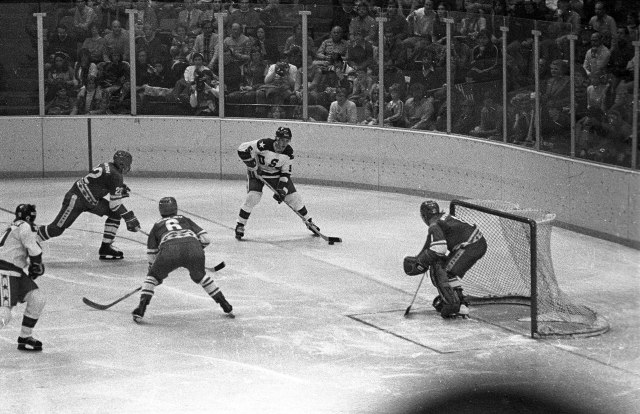
The defining moment of the amateur era came at the 1980 Winter Olympics in Lake Placid. The United States team, made up almost entirely of collegiate players and led by coach Herb Brooks, defeated the heavily favored Soviet squad in what became known as the “Miracle on Ice.” The victory symbolized the ability of college athletes to compete against the world’s best under Olympic amateur rules.
That model, however, was nearing its end. By the late 1980s and early 1990s, the International Olympic Committee began dismantling amateur restrictions across multiple sports. Ice hockey followed. Beginning with the 1998 Winter Olympics in Nagano, NHL players were officially allowed to participate, a shift that fundamentally changed Olympic hockey history.
The inclusion of professionals transformed the tournament. National teams became all-star lineups filled with elite NHL talent. Games grew faster, more physical, and more tactically advanced. Olympic hockey increasingly resembled an extension of the NHL season, reflecting the league’s global influence rather than the developmental roots described in early professional hockey history.
Yet something was lost alongside those gains. The collegiate-era Olympics carried a distinct identity built on development, opportunity, and unpredictability. College players represented future potential rather than established dominance, creating moments that resonated far beyond medals and standings.
The contrast between NHL professionals and collegiate players in the Winter Olympics ultimately reflects two philosophies of sport. One prioritizes peak performance and star power. The other values growth, teamwork, and the improbable. Together, they illustrate how Olympic hockey has evolved from its amateur roots into a modern global spectacle.


 The Sports Archives Blog