
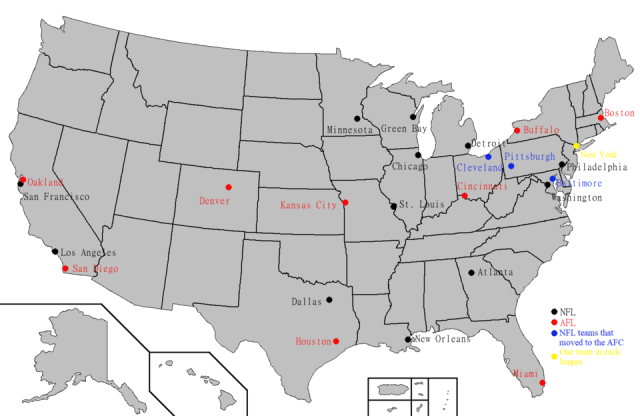
AFL and NFL teams at the time of the 1970 merger.
Source: Wikimedia Commons (public domain).
By the end of the 1960s, professional football in America had outgrown its small-town roots and turned into a billion-dollar battleground. Two rival leagues, the established National Football League (NFL) and the upstart American Football League (AFL), were locked in a costly arms race for players, fans, and television contracts. Their rivalry would culminate in one of the most important agreements in sports history: the 1970 AFL–NFL merger, which unified the game, reshaped the business of sports, and paved the way for the modern Super Bowl era.
The Rival Leagues
When the AFL launched in 1960, most sportswriters dismissed it as a fad. But its young, aggressive owners, including Lamar Hunt of the Kansas City Chiefs and Bud Adams of the Houston Oilers , were determined to challenge the NFL’s dominance. They built teams in new markets like Dallas, Denver, and Oakland, and they weren’t afraid to spend big. The leagues began an all-out bidding war for college talent, driving player salaries to unsustainable heights.
The AFL’s innovations, colorful uniforms, televised games, and wide-open offensive play, began to win fans, especially among younger audiences. Meanwhile, the NFL’s traditional franchises still commanded national prestige. But by 1966, both sides realized they were bleeding money and needed peace.
The Merger Agreement
On June 8, 1966, NFL Commissioner Pete Rozelle and AFL founder Lamar Hunt announced a historic merger agreement. The two leagues would combine under the NFL name beginning with the 1970 season. Until then, they would maintain separate schedules but play a championship game each year, an event soon dubbed the Super Bowl.
The merger required approval from the U.S. Congress, which granted antitrust exemptions in exchange for the creation of two new franchises: the New Orleans Saints and the Cincinnati Bengals. It also established a single draft, shared television revenue, and a new league structure featuring two conferences, the AFC and the NFC, each with three divisions.
The First Unified Season
The 1970 season marked the first fully integrated NFL campaign, with 26 teams playing under one banner. The newly formed American Football Conference consisted mostly of former AFL teams, while the National Football Conference housed traditional NFL powers. That fall, fans saw the birth of modern football as we know it, unified schedules, standardized rules, and a national television presence that elevated Sunday football into a weekly ritual.
The Super Bowl quickly became the sport’s crown jewel. What began as an experimental championship game in 1967 now symbolized the success of the merger itself. By the mid-1970s, the NFL had become America’s most-watched sport, overtaking baseball in television ratings and cultural impact.
Lasting Legacy
The AFL–NFL merger was more than a business deal; it was the blueprint for modern professional sports. It unified schedules, created parity through the draft and revenue sharing, and proved that cooperation, not rivalry, could make the game stronger. Today’s 32-team NFL, with billion-dollar broadcast contracts and global reach, still stands on the foundation laid by that 1970 agreement.


 The Sports Archives Blog